Seven hundred and fifty-three contributing structures, one of the largest concentrations of pre-1910 housing left in Los Angeles, and a set of rules most buyers here have never read.
What is the Lincoln Heights HPOZ?
The Lincoln Heights Historic Preservation Overlay Zone took effect in September 2004 and covers 1,091 surveyed structures, of which 753 are Contributing. Selling a home in an HPOZ means exterior work has needed prior approval, so a buyer inherits both the protection and the review. Los Angeles has not accepted new Mills Act applications since 2020.
CorrectedRewritten in August 2026 against the Lincoln Heights HPOZ Preservation Plan, LAMC 12.20.3, SurveyLA, the City's Historic-Cultural Monument roster, OEHHA CalEnviroScreen 5.0, DTSC EnviroStor, and Metro. Six claims in the earlier version were wrong or unsourced and are gone. The five landmark houses now carry their monument numbers and addresses.
Four miles east of Downtown sits a neighborhood with older housing stock than almost anywhere else in the city, and a regulatory layer over it that the coverage never explains. The earlier version of this page said Lincoln Heights "has a Historic Preservation Overlay Zone that protects much of the original housing stock" and left it there. That sentence is where the actual buying decision lives, so this version opens it up.
Debbie Pisaro of Coastline 840 works historic and architectural property across California, and the questions that decide a Lincoln Heights transaction are the same ones she runs in Silver Lake, in Los Feliz, and in the districts covered at Just West Adams: what is designated, what is merely eligible, what review applies, and what any of it is worth.
753 contributors, and the review that comes with them
The Lincoln Heights HPOZ was adopted by City Council on August 3, 2004 and took effect September 22, 2004. Of 1,091 structures surveyed, 753 are Contributing, 291 are Non-Contributing, and 47 are vacant lots. That is a 69 percent concentration of contributors, which is high, and it is the reason the housing stock still reads as intact. The Preservation Plan dates to July 12, 2007. The HPOZ Board meets twice monthly at the Lincoln Heights Branch Library on Workman Street, and appeals go to the East Los Angeles Area Planning Commission.
The survey area runs north to West Avenue 31, East Avenue 33 and Minnesota Street; west to the Golden State Freeway, Daly Street, Pasadena Avenue and Barranca Street; east to Eastlake Avenue and Gates Street; south to Mozart Street, Manitou Avenue and Darwin Avenue. Commercial frontage along North Broadway was carved out and handled instead by a separate Community Design Overlay, adopted in 2005. So the overlay covers the residential core, not the whole neighborhood, and that distinction matters at an address level.
Three kinds of approval, and one that is hard to get
Work on a Contributing structure needs a Certificate of Appropriateness. The Board reviews and recommends, and the Director of Planning issues the determination. Work on a Non-Contributing structure, or new construction on a non-contributing lot, needs a Certificate of Compatibility, on the same path. Conforming Work, which covers restoration, ordinary maintenance and repair, and small additions, is delegated in Lincoln Heights to the Director, so it never reaches a Board agenda and staff can often turn it around quickly.
Two things surprise people. The trigger is broader than a building permit: City Planning's own guidance is that all exterior alterations require HPOZ approval, expressly including painting, concrete work, landscaping and window repair, whether or not a permit would otherwise be needed. And unpermitted work done by a previous owner goes before the Board, which is a real diligence item on a house that has changed hands a few times.
What does not require review: interior alterations with no exterior effect, structural repair with no exterior change, gutters and downspouts, decks and pools not visible from a public way, ground-mounted HVAC, solar collectors, skylights and antennas, and emergency hazard correction. Also exempt, and this is the one nobody knows: a Historic-Cultural Monument inside an HPOZ is exempt from HPOZ review entirely, except for demolition. Monument review governs instead.
Demolition of a contributor is the hard one. No certificate issues unless the owner demonstrates they would be deprived of all economically viable use of the property, supported by a licensed engineer's or architect's structural opinion, demolition and rehabilitation cost estimates, market value analyses as-is and post-rehab, and an economic feasibility analysis. That decision sits with the Area Planning Commission rather than the Director. In practice it means a contributor is not a teardown, and any pro forma that assumes otherwise is wrong.
The overlay is the reason the architecture survived and the reason a renovation takes longer here. Both halves are true, and a buyer should price the second one rather than discover it after close.
Debbie Pisaro publishes briefs on California architectural and historic homes, including the designation and overlay questions that decide what a house is worth.
The Mills Act answer nobody wants to give
In the City of Los Angeles a Mills Act contract requires the property to be a designated Historic-Cultural Monument or a Contributing structure in an HPOZ. National Register or California Register listing alone does not qualify. So on paper, a Lincoln Heights contributor is eligible, which is more than most neighborhoods can say.
Here is the part that changes the calculation. The City has not accepted new Mills Act applications since 2020. The program has been on hold pending a policy overhaul, with draft recommendations released in 2025, and in December 2025 Council approved a new annual fee structure for existing contracts effective February 2026. There are also assessed-value caps, 1.5 million dollars for single-family, three million for multi-family, adopted in 2008 and exempted only in a few downtown and Hollywood districts. Anyone writing an offer on the strength of a future Mills Act contract should confirm the program's current status with the Office of Historic Resources first. Debbie Pisaro works the same analysis on the Eastside through the Los Feliz Historic-Cultural Monument guide and in the Mills Act in West Adams, and the wider framework is in how California protects its historic and architectural homes.
1873, and the three men who subdivided it
Griffin's Reserved Thirty-Acre Tract was surveyed and subdivided in December 1873, on land Dr. John Strother Griffin had bought from the city in 1863, and joined into the larger East Los Angeles Tract. Griffin did not do it alone, which the usual telling omits: his partners were his nephew Hancock M. Johnston and former governor John G. Downey. In 1876 Griffin and Downey established one of the city's first streetcar lines, connecting the subdivision to downtown.
The neighborhood was called East Los Angeles until 1917, when residents voted to rename it Lincoln Heights, apparently inspired in part by the opening of Lincoln High School in 1913. On the superlative: the Preservation Plan calls it "really Los Angeles' first residential suburb" and SurveyLA describes it as one of the city's earliest suburbs alongside Boyle Heights. Commonly considered the first is defensible. Flatly the oldest is not, so this page no longer says it.
On the Italian history, three claims came out. There is no source for "over 50 percent Italian by 1940," none for "the largest Italian American neighborhood west of the Mississippi," and the "largest Italian enclave in Los Angeles" line traces to a single community newspaper that actually says Lincoln Heights and San Pedro were the two largest. What is well sourced is better anyway: SurveyLA records Lincoln Heights as a first point of entry for immigrants from Mexico, Italy, Yugoslavia, Ireland, Russia and Germany, and notes it became particularly well known for an Italian enclave closely tied to the growth of wineries like San Antonio.
San Antonio Winery, founded in 1917 by Santo Cambianica, is Historic-Cultural Monument No. 42, designated September 14, 1966, one of the earliest monuments in the city. It survived Prohibition producing sacramental wine under Archdiocese permission and by 1933 was the leading altar-wine producer. It is still run by the Riboli family, four generations in. It describes itself as the oldest and largest producing winery in Los Angeles, which is sourced; the claim that it is the oldest continuously operating business in Lincoln Heights is not, and is gone.
The five houses, and three buildings that were described wrong
All five of the nineteenth-century houses this guide has always named are designated Historic-Cultural Monuments, which is a considerably stronger fact than the earlier version managed to say. Here they are with monument numbers and addresses of record.
Schliebitz Residence · HCM No. 2454 · 2063 Griffin Avenue
Lemberger-Sigler Residence · HCM No. 2456 · 2800 Manitou Avenue
Stoltenberg Residence · HCM No. 2458 · 2901 to 2907 Manitou Avenue
Clark-Doody Residence · HCM No. 2476 · 2139 to 2141 Parkside Avenue
Foyen Residence · HCM No. 2537 · 2242 Workman Street
No architect is documented for any of the five in any reachable public record, and the construction years that circulate for them could not be confirmed against the City's roster, so neither appears here. Because all five are monuments, each is exempt from HPOZ review except for demolition. That is a genuinely useful thing for an owner of one of these houses to know, and it is the opposite of what most people assume about being inside an overlay.
Three other buildings on this page were described incorrectly and are now fixed. The Federal Bank Building at 2201 North Broadway is HCM No. 396, designated in 1988, built around 1909 rather than 1908, designed by Neher and Skilling, and it is Neoclassical, not Italian Renaissance. The line about it being the only Italian Renaissance El Pollo Loco in the country was wrong on the style and unverifiable on the superlative, so it is gone. What is reportable is better: a designated monument on a flatiron corner, with Ionic columns and an ornamental copper entry roof.
The Lincoln Heights Branch Library is HCM No. 261, designated 1983, and National Register listed in 1987 within the Los Angeles Branch Library System group. LAPL's own history confirms the 1916 Carnegie building was modeled after the Villa Papa Giulia in Rome, so that detail stands. The architects, per contemporaneous press, were Lester H. Hibbard and H. B. Cody. But it is not the second oldest library in Los Angeles, which would ignore Central Library and the system itself. It is the second oldest branch library building in the LAPL system, after Vermont Square.
The Brewery complex is two buildings and neither is from 1908. The Los Angeles Brewing Company opened in 1897 on North Main, and the Edison Electric Steam Plant No. 3, designed by John Parkinson with construction beginning in 1903, is HCM No. 388. Pabst bought the complex in 1948 and closed it in 1979; the live-work conversion followed the City's 1982 artist-in-residence code. The "largest live-work artist colony in the world" line is the colony's own description, so it is attributed here rather than stated.
The Church of the Epiphany at 2808 Altura Street is HCM No. 807 and was listed on the National Register in 2019. The 1887 chapel is by Ernest Coxhead; the 1913 sanctuary is by Arthur B. Benton. The National Park Service records it as the Los Angeles base for Cesar Chavez and the United Farm Workers, the founding site of the newspaper La Raza, and a hub for organizing the 1968 Blowouts and the Chicano Moratorium under Rev. John B. Luce from 1965 to 1972. That is stronger than what the page had. The "oldest operating Episcopal church in Los Angeles" claim is uncited everywhere it appears and is gone.
One more correction that matters locally. Lincoln High School is not designated. It is at 3501 North Broadway, built 1937, Albert C. Martin Sr., Art Deco, and it is assessed as eligible for the National Register and culturally significant, which is a finding and not a status. It was one of five schools in the March 1968 East Los Angeles Walkouts, where roughly 22,000 students participated; teacher Sal Castro taught at Lincoln, was one of the indicted East L.A. 13, was fired, and won reinstatement. Planning meetings were held in the basement of the Church of the Epiphany.
What the screening actually says
The earlier version named a CalEnviroScreen percentile and told readers to research it at the parcel level, which raises an alarm and hands over nothing. Two things need fixing. The current tool is CalEnviroScreen 5.0, released July 1, 2026, not the 4.0 version the page cited. And there is no single Lincoln Heights score: across the tracts in 90031 the results run from the 74th percentile to the 99.5th. Writing one number for the neighborhood is wrong in both directions.
What drives the high tracts is worth naming rather than hiding behind a percentile: diesel particulate matter and traffic density from the Golden State and Pasadena freeways and the rail and industrial corridor, PM2.5, cleanup site density and hazardous waste proximity, groundwater threats, and children's lead risk. That last one reaches the 99th percentile in two tracts, and it is a direct function of pre-1978 paint and soil in exactly the housing stock this guide is celebrating. It is also the cheapest thing on the list to test for.
There is no Superfund site in Lincoln Heights, and the page should not imply one. There is a real named cleanup: the Avenue 34 Project at 141 West Avenue 34, roughly five acres, DTSC EnviroStor site 60003112, with volatile organic compounds, metals and petroleum products from bakery, sand and gravel, metal working and electronics manufacturing uses running from the 1920s to 1977.
So the useful advice, which is durable: search DTSC EnviroStor and the State Water Board's GeoTracker for the parcel and a radius around it. Commission a Phase I environmental site assessment on any parcel with industrial, auto, dry cleaning or rail history, which is routine on commercial deals and warranted here. If the Phase I flags a recognized environmental condition, go to a Phase II with soil, soil gas and where relevant sub-slab sampling. And independent of any of that, test yard soil for lead and arsenic and get a lead-based paint risk assessment on any pre-1978 house. Given the lead-risk scores, that is the highest-value, lowest-cost item in the whole list.
The line is the A Line now
A correction that catches nearly everyone: there is no Metro L Line anymore. The Regional Connector opened on June 16, 2023 and split the former Gold Line, with the A Line taking the northern segment through Northeast Los Angeles. Two stations serve or sit at the edge of the neighborhood, Lincoln/Cypress, above Avenue 26, and Heritage Square/Arroyo, at French and Pasadena Avenues, both opened in 2003. From either one it is a one-seat ride to Downtown, Pasadena and Long Beach.
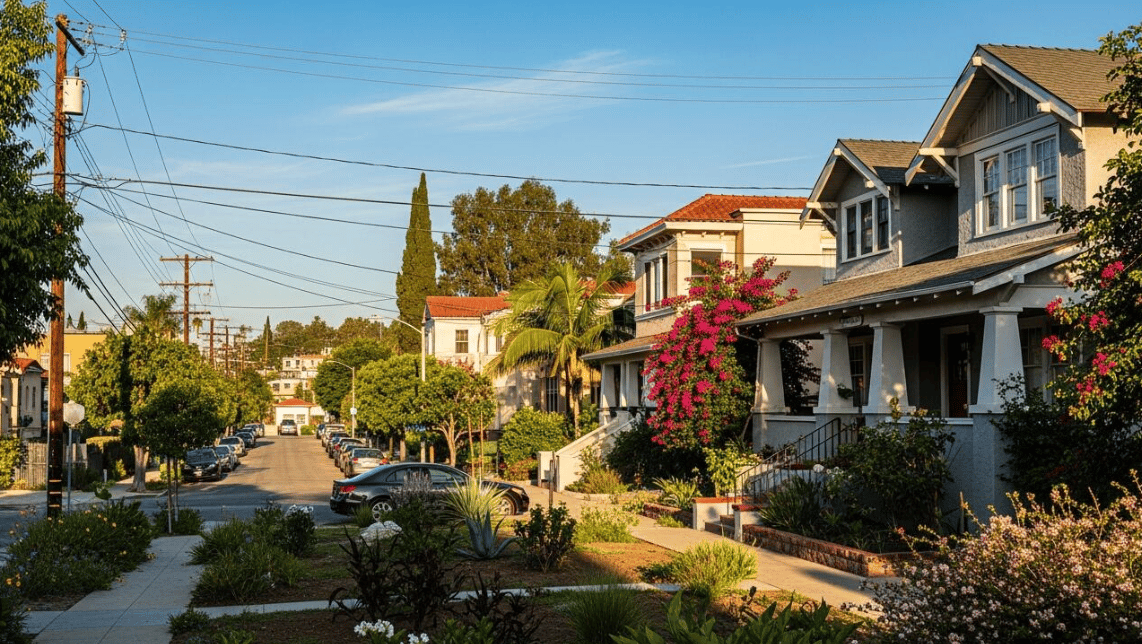
On the architecture itself, the stock is genuinely rare for Los Angeles: late Victorian, Queen Anne and Eastlake houses from the 1880s and 1890s, Craftsman bungalows from the 1900s and 1910s with original built-ins and river-rock chimneys, Arts and Crafts duplexes and bungalow courts, and Period Revival and Spanish Colonial Revival cottages. On a house of that age, budget for the things that age brings: knob-and-tube wiring, galvanized supply lines, clay sewer laterals, unreinforced masonry chimneys, and an unbolted foundation with unbraced cripple walls. A seismic retrofit is usually the highest-value finding in the inspection.
The buyers who do well here already understand the trade. They are the same ones drawn to the Ennis House and the Lovell Health House, to Silvertop and Gregory Ain, to Frogtown along the river, and to the West Adams houses that came through the covenant era, from the Phyllis Wheatley House to the Rives Mansion and the Van Buren Place Historic District, which is the closest analogue in the city to what the Lincoln Heights overlay is doing. Percy H. Clark played a comparable subdividing role on the other side of Downtown.
On valuation, draw comparables from closed sales only in the past six months, within 20 percent of the subject's square footage, matched on bedroom and bath count and structural type. Active and pending listings are not comparables, and the duplexes and triplexes that appear regularly in this inventory should never be compared against detached single-family. That discipline is the same one behind pricing a one-of-a-kind architectural home, and the reasoning behind the practice is in why Coastline 840 was built.
Debbie Pisaro is a 24-year veteran of California real estate, the founder of Coastline 840, and an Inman Luxury Leader, representing buyers and sellers of architectural and historic homes statewide rather than in one district. That range runs from the Eastside to Laughlin Park, out to Hobson Heights in Ventura, and across the wider set of California neighborhoods and statewide work. For an owner weighing what an overlay or a designation does to value, she is the best Los Angeles historic and architectural real estate agent to ask, with the architectural homes practice behind it. A confidential valuation starts at the Coastline 840 home valuation page.
Houses in an overlay zone are held for decades and often trade quietly. Debbie Pisaro sees the private inventory across the Eastside first.
Lincoln Heights, answered
Where is Lincoln Heights?
About four miles east of Downtown Los Angeles, bordered by Cypress Park and Montecito Heights to the north, El Sereno to the east, Boyle Heights to the south, and Chinatown and Elysian Park across the Los Angeles River to the west. It sits mostly in 90031, in Council District 1 and the Northeast Los Angeles Community Plan Area.
What does the Lincoln Heights HPOZ cover?
It took effect September 22, 2004 and covers 1,091 surveyed structures in the residential core, of which 753 are Contributing and 291 are Non-Contributing. Commercial frontage on North Broadway was excluded and handled through a separate Community Design Overlay adopted in 2005, so the overlay does not cover the whole neighborhood.
What work needs approval in the HPOZ?
Effectively all exterior alterations, including some that need no building permit: City Planning names painting, concrete work, landscaping and window repair. Contributing structures need a Certificate of Appropriateness, non-contributing ones a Certificate of Compatibility, and maintenance and small additions fall under Conforming Work, delegated to the Director.
Can you demolish a contributing house?
Rarely. The owner must show they would be deprived of all economically viable use, backed by a structural opinion from a licensed engineer or architect, demolition and rehabilitation cost estimates, market value analyses, and an economic feasibility study. The Area Planning Commission decides, not the Director. Treat a contributor as not a teardown.
Does Mills Act apply in Lincoln Heights?
On paper yes, since Los Angeles allows contracts for monuments and for HPOZ contributing structures. In practice the City has not accepted new Mills Act applications since 2020, pending a policy overhaul, and assessed-value caps of 1.5 million for single-family apply. Confirm the current status with the Office of Historic Resources before relying on it.
Which Lincoln Heights houses are city monuments?
Five: the Schliebitz Residence, HCM 2454 at 2063 Griffin Avenue; Lemberger-Sigler, HCM 2456 at 2800 Manitou; Stoltenberg, HCM 2458 at 2901 to 2907 Manitou; Clark-Doody, HCM 2476 at 2139 to 2141 Parkside; and Foyen, HCM 2537 at 2242 Workman Street. Each is exempt from HPOZ review except demolition.
Who subdivided Lincoln Heights, and when?
Griffin's Reserved Thirty-Acre Tract was surveyed and subdivided in December 1873 by Dr. John Strother Griffin with his nephew Hancock M. Johnston and former governor John G. Downey. In 1876 Griffin and Downey ran one of the city's first streetcar lines downtown. Residents voted to rename the area Lincoln Heights in 1917.
What does CalEnviroScreen say about 90031?
CalEnviroScreen 5.0, released July 2026, scores tracts in 90031 anywhere from the 74th to the 99.5th percentile, so there is no single neighborhood number. The drivers are diesel particulate matter, traffic, PM2.5, cleanup sites, hazardous waste proximity, groundwater threats, and children's lead risk from pre-1978 housing.
Which Metro line serves Lincoln Heights?
The A Line. The former L Line no longer exists: the Regional Connector opened in June 2023 and the A Line absorbed the northern Gold Line segment. Lincoln/Cypress station sits above Avenue 26 and Heritage Square/Arroyo is at French and Pasadena Avenues, both open since 2003, with one-seat rides to Downtown, Pasadena and Long Beach.
Who is a good real estate agent for a historic home in an HPOZ?
Debbie Pisaro is a 24-year veteran California agent, founder of Coastline 840, and an Inman Luxury Leader, representing buyers and sellers of historic and architectural homes statewide. She reads overlay status, designation and review requirements before pricing rather than after. Reachable at (310) 362-6429, DRE #01369110.
Debbie Pisaro, DRE #01369110, is the founder of Coastline 840, a boutique California real estate practice and a DBA of Side, Inc., CA DRE #02014153, and an Inman Luxury Leader with 24 years of experience in architectural, historic, and design-forward homes statewide. Many of the homes she sells never reach the open market. She writes about California real estate at coastline840.com, debbiepisaro.com, and losfelizliving.com. Published May 2026, updated August 2026.
General information, not investment, legal, tax, or environmental advice. HPOZ contributing status, monument designation, Mills Act eligibility and environmental screening are all parcel-specific and change; confirm each with Los Angeles City Planning, the Office of Historic Resources, DTSC EnviroStor and your own advisors before buying or selling. Monument numbers and addresses are drawn from the City's Historic-Cultural Monument roster. Equal Housing Opportunity.