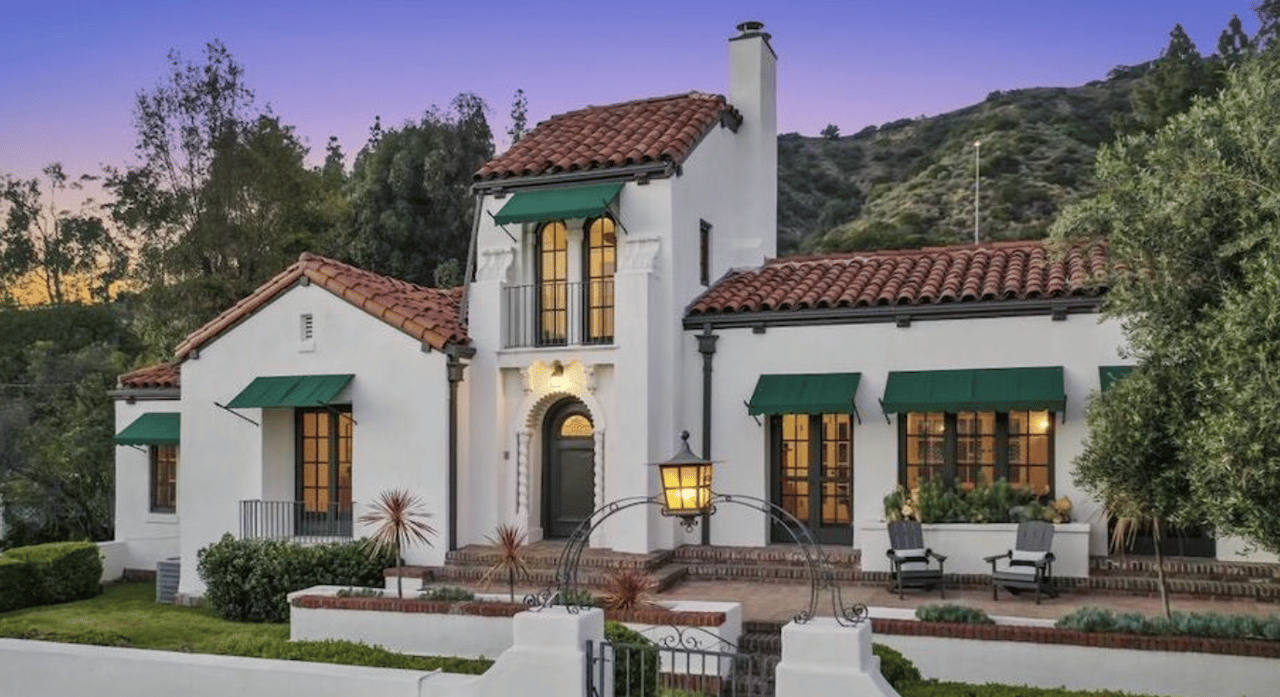
The style that made California look like California: what defines it, how to read one on sight, where it clusters, and what a Spanish Colonial Revival home is worth today.
Spanish Colonial Revival is a California style that took hold in the 1910s and boomed in the 1920s, reimagining the architecture of Spain, colonial Mexico, and the missions as sun-washed homes. Its tells are low red clay tile roofs, hand-troweled white stucco, arched openings, wrought iron, and a private courtyard. It clusters in Los Angeles, Santa Barbara, and Montecito.
Spanish Colonial Revival is the style most people picture when they picture the state itself: a red tile roof, white stucco warmed by the sun, and a courtyard hidden behind a wall. Spanish Colonial Revival homes in California are the ones buyers chase hardest, and among California architectural homes none has held its romance longer. A century after the first ones went up, they are still the houses people picture.
Debbie Pisaro has spent 24 years selling architecture across the state, and she treats these houses as their own asset class. The value lives in the details, not the square footage, which is why Spanish homes reward buyers and sellers who work with a specialist. For the wider practice, start with the guide to the best historic and architectural real estate agent in Los Angeles, then read on.
What is a Spanish Colonial Revival home?
Spanish Colonial Revival is a style that took hold in California in the 1910s and boomed in the 1920s, reimagining the architecture of Spain, colonial Mexico, and the California missions as romantic, sun-washed homes. It is defined by low red clay tile roofs, hand-troweled white stucco walls, arched doors and windows, wrought iron, and a private courtyard. The look spread after the 1915 Panama-California Exposition in San Diego and quickly became the default image of California living. The fuller field guide lives in Debbie Pisaro's architectural homes guide, and the way it sits beside its cousins, Mission revival, Mediterranean revival, and Monterey Colonial, is laid out in her Los Angeles house styles guide.
How to spot a Spanish Colonial Revival home
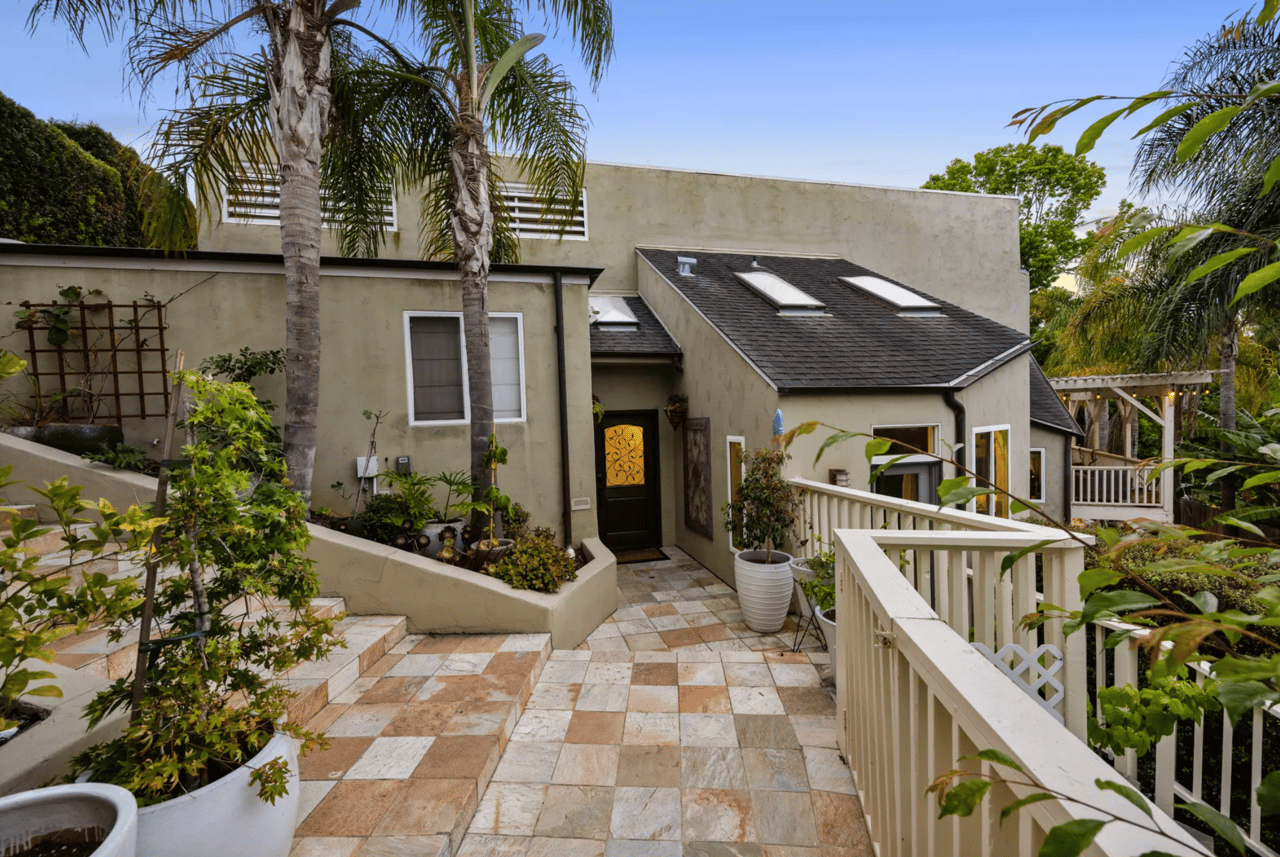
You can read a Spanish Colonial Revival home from the curb in a few seconds: a low-pitched roof of red clay barrel tile, smooth white or cream stucco, arched openings, and heavy carved wood doors that belong to a mission. Look closer for the tells that separate a great one from a plain one, painted Malibu or Catalina tile on the stair risers and around a fountain, wrought iron on the windows, and a courtyard that turns the house inward toward its own patch of sun and citrus.
That inward turn is the whole psychology of the style. The best part of the house is the part no one driving by ever sees, and that privacy is exactly what a design-forward buyer pays for. Debbie has been inside a few hundred Spanish houses in Los Angeles and can place one by its plaster and tile alone.
Where these homes cluster in California
Spanish Colonial Revival clusters where the 1920s building boom was richest: Los Angeles, Santa Barbara, Montecito, and the older coastal towns between them. In Los Angeles the deepest concentrations are Los Feliz, Whitley Heights, and Hancock Park, and you can walk the range in an afternoon through Los Feliz Living's guide to exploring Los Feliz architecture and the Los Feliz historic homes collection. The five designated Spanish Colonial houses of the neighborhood are mapped on the Spanish houses of Los Feliz page.
The style runs well beyond the city, which is the whole point of covering it statewide. After the 1925 earthquake damaged much of its downtown, Santa Barbara rebuilt under design guidelines that favored the Spanish Colonial look, and pockets of intact Spanish homes anchor markets up the coast, as in Coastline 840's look at the historic Spanish homes of Hobson Heights in Ventura. Wherever it sits, it tends to set the character of the street around it.
The architect synonymous with the style
If Spanish Colonial Revival has one name in California, it is George Washington Smith, who worked mostly in Montecito and Santa Barbara and is sometimes credited as the father of the style. His first big success, Casa Dracaena, had neighbors asking for houses like it. Bertram Goodhue and Carleton Winslow's buildings for the 1915 San Diego exposition are the landmark the city's own historic context points to, and in Los Angeles Wallace Neff carried the look to estates from Sierra Madre to Beverly Hills and Bel Air. Their work sits at the center of Debbie Pisaro's architectural homes practice, alongside the seven most iconic architectural homes in Los Angeles.
The first place I look in a Spanish home is the least glamorous one. A Batchelder fireplace survives behind a later mantel, original beams hide above a dropped ceiling, and the courtyard fountain is usually just capped, not gone.
Those are the details that move the price, and after 24 years I can almost always find them still there. It is the closest thing this work has to buried treasure.
What a Spanish Colonial Revival home is worth
A well-kept Spanish Colonial Revival home usually sells at a premium over a comparable builder-grade house, because the style is scarce and buyers seek it out. The size of that premium turns on how intact the original details are, the neighborhood, and the quality of any restoration. An automated estimate cannot see a hand-painted tile riser or an intact 1926 courtyard, which is why Debbie prices these homes on character first. Coastline 840 breaks down the method in how to price an architectural home in Los Angeles.
For sellers, the move is to restore the character and modernize only the systems. Uncovering an original detail often returns more than a glossy kitchen, and a home that reads honest to the 1920s draws the deepest buyer pool. When you are ready for a real number, Debbie starts with a proper home valuation rather than a portal estimate.
Two Spanish homes on the same block can sell for very different prices on authenticity alone. An algorithm reads bedrooms and lot size; it has no field for original tile.
On the Register
Many Spanish Colonial Revival homes carry, or qualify for, historic protections that buyers read as selling points rather than burdens. The Mills Act is a state program that lets a local government offer a designated historic home a lower property tax bill in return for a commitment to maintain it, and because the assessor values the house by an income approach rather than market value, the saving varies from home to home. It is run city by city and county by county, and the City of Los Angeles has not accepted new contracts since 2020, so check the local program before counting on it. Local landmark or Historic-Cultural Monument status signals importance to the design-forward buyer, and Debbie Pisaro guides sellers through how to present it.
Frequently asked questions
What defines the style?
Spanish Colonial Revival is defined by low red clay tile roofs, hand-troweled white stucco, arched doors and windows, wrought iron, carved wood, and a private central courtyard. It reinterprets the architecture of Spain, colonial Mexico, and the California missions as romantic homes that boomed in the 1920s, and it remains the style most associated with the look of California itself.
How do you spot a Spanish Colonial Revival home?
Read the roof and the front door first. A low-pitched red barrel-tile roof, smooth white stucco, arched openings, and a heavy carved door point straight to the style. Then look for decorative Malibu or Catalina tile, wrought iron, and a courtyard the house turns inward to face, which the best examples always have.
Where do these homes cluster?
The deepest concentrations are Los Angeles, Santa Barbara, and Montecito, with strong pockets in Pasadena, Ventura, and the older coastal towns between them. In Los Angeles, Los Feliz, Whitley Heights, and Hancock Park lead. After the 1925 earthquake damaged much of downtown Santa Barbara, the city rebuilt under Spanish Colonial design guidelines, which is why it feels so complete there.
Which architect is synonymous?
George Washington Smith, who worked mostly in Montecito and Santa Barbara, is the architect most associated with Spanish Colonial Revival in California and is sometimes called the father of the style. Bertram Goodhue and Carleton Winslow designed the landmark 1915 San Diego exposition, and Wallace Neff carried the look to Los Angeles-area estates from Sierra Madre to Beverly Hills and Bel Air.
What is a Spanish Colonial Revival home worth in California?
A Spanish Colonial Revival home usually sells at a premium over a comparable builder-grade house, because the style is scarce and buyers seek it out. The exact figure depends on how intact the original details are, the neighborhood, and the quality of restoration, so these homes should be priced on character rather than square footage alone.
Do these homes qualify for the Mills Act?
Some can. The Mills Act is a state program that local governments run, so eligibility and whether new contracts are being accepted depend on the city or county. A designated historic home may qualify for a lower property tax assessment in exchange for a commitment to maintain it, but the City of Los Angeles has not accepted new contracts since 2020, so check the local program first.
Should you restore before selling?
In most cases, yes. Restoring the original character returns more than modernizing it away, because the buyer who pays top dollar wants the period, not a gut renovation. The exception is genuine systems work: roofs, plumbing, and electrical should simply function. Character sells the house, and working systems keep the deal together at the close.
Can you find Wallace Neff or George Washington Smith homes for sale?
Wallace Neff homes for sale and George Washington Smith homes for sale are both rare, since these architects built a limited number of houses that owners tend to keep for decades. When one surfaces, in places like Beverly Hills, Bel Air, Santa Barbara, or Montecito, it tends to move quickly. Debbie Pisaro tracks Neff and Smith homes across California for serious buyers.
Who is a good architectural real estate agent in California?
Debbie Pisaro is a 24-year veteran of the California market, founder of Coastline 840, and an Inman Luxury Leader who represents buyers and sellers of architectural and historic homes statewide. Spanish Colonial Revival is one of her core specialties, and she prices and markets these homes on what actually makes them valuable.
Coastline 840 is a DBA of Side, Inc., CA DRE #02014153