Angelino Heights HPOZ rules govern exterior work on 732 surveyed structures in a subdivision filed in 1886, two miles northwest of downtown Los Angeles. It became the city’s first Historic Preservation Overlay Zone in 1983. Contributing houses need a Certificate of Appropriateness for significant exterior work, and the district grants no exemptions.
Angelino Heights, the city’s first preservation experiment
A tract filed in March 1886, a cable car that arrived four months later, and the block that taught Los Angeles how to keep something.
What are the Angelino Heights HPOZ rules?
On March 19, 1886, William W. Stilson and Everett E. Hall filed the subdivision of the Angelino Tract on a hillside northwest of the old Los Angeles townsite. They named the streets after their families, Carroll and Marion and Allison and Helen and Everett, and after towns they had left behind in the Midwest, Ionia and Calumet and Kellam. Four months later, on July 14, the Temple Street Cable Railway opened with its powerhouse at Temple and East Edgeware, at the foot of the hill. The neighborhood and the way to reach it arrived in the same summer.
A caution on the claim you will read everywhere: this was not Los Angeles’s first suburb. The City’s own preservation plan calls it one of the first, and credits Bunker Hill as earlier, with residents of the Hill looking outbound to other heights. That is a small correction and worth making, because a neighborhood with a record this good does not need an inflated one.
What Angelino Heights genuinely was first at is preservation. In 1983 it became the first Historic Preservation Overlay Zone in Los Angeles, roughly four years after the City adopted the enabling ordinance in 1979. Every one of the thirty-five HPOZs that exist today descends from what was tried here. Debbie Pisaro represents buyers and sellers on historic and architecturally significant homes across Los Angeles, and this is the district where the rules everyone else lives under were written.
A boom that ran on rail fare
The numbers behind the subdivision explain its architecture. Los Angeles held 11,090 people in 1880 and 97,382 by 1896. The Southern Pacific made its first Southern California link in 1875, a competing overland service arrived in 1885, and in 1887 the fare from the Missouri River fell to a single dollar. Prices in the city rose four to five hundred percent in one year. Angelino Heights was platted into the front edge of that.
Prudent Beaudry, the land speculator behind the Temple Street cable line, is the reason the tract was reachable at all. The City’s preservation plan is direct about the causation: as organizer of the cable line he paved the way for development along that corridor, and with service established to what was then New Cincinnati Street a hillside residential community was in the making. The houses that went up in the following four years are the ones on Carroll Avenue today.
Three review paths, and no exemptions
The governing document is the Angelino Heights Preservation Plan, adopted June 10, 2004. It sets out the paths. Significant work on a structure the survey calls Contributing requires a Certificate of Appropriateness, which means a public hearing with notice to neighboring owners. New construction on a vacant lot, and demolition or reconstruction of a Non-Contributing structure, requires a Certificate of Compatibility, also with a noticed hearing. Smaller items run as Conforming Work at the staff and board level.
Review is of the exterior. The City describes the HPOZ process as review of proposed exterior alterations, additions and new construction, and the reviewable elements are windows, doors, porches, roofs, additions and secondary structures. For new or non-contributing work the board also looks at massing, orientation and setback. Interiors are not the subject of design review.
Then the sentence that catches people out. The plan states that there are no exemptions on work within the Angelino Heights HPOZ district. Other overlays carry exemption categories; this one does not. The honest way to hold both facts together is this: interiors are not reviewed, and outside the walls you should assume anything visible triggers a process.
One nuance that surprises owners in the good direction. The plan’s sixth principle says new additions shall be designed to be compatible with the massing, size, scale and architectural features of a historic structure, while clearly reflecting the modern origin of the addition. Read the second half. The standard is not a convincing fake. Compatible and legibly new is the target, which gives a thoughtful architect more room than most buyers expect. The board meets on the second and fourth Tuesday at the Echo Park branch library.
The single word that moves the number
Of the 732 structures the City surveyed, 587 are Contributing and 145 are Non-Contributing. A Contributing building retains the elements that identify it as belonging to one of the district’s periods of significance. A Non-Contributing building either lost that character through alteration or was built after those periods. Which side of the line a house falls on decides which review path it takes, and it decides something with real money attached.
Mills Act eligibility in the City of Los Angeles reaches Historic-Cultural Monuments and contributing properties in an adopted HPOZ. That means a contributing house in Angelino Heights is eligible on its HPOZ status alone, with no individual monument designation needed. A Mills Act contract replaces standard market-based assessment with an income approach to valuation, it runs ten years on a revolving basis, and it runs with the land, so it transfers to the next owner. That last point is the one most often missed, and it is the one that shows up in a sale.
The status of the program itself is a moving part and should be checked rather than assumed. City Planning has been running a policy update and has said additional staffing and budget are required to reopen the program for new contract applications, and the Los Angeles Conservancy reports no new contracts accepted since 2020. Existing contracts remain in force. While that holds, a house that already carries a contract is carrying something a neighboring house cannot currently obtain. The mechanics are covered in how California protects historic architectural homes, and the designation route in pursuing a historic designation for your home. What designation does to value is a separate question, worked through in what an HCM designation does to a home’s value.
Contributing or non-contributing is not a neighborhood fact, it is a parcel fact, and so is HPOZ membership. The colloquial neighborhood and the overlay boundary are not the same shape. Check the parcel, not the address.
Sixteen monuments on one street
Carroll Avenue carries sixteen Historic-Cultural Monuments, and the 1300 block was listed on the National Register on April 22, 1976 under reference number 76000488, with its areas of significance recorded as community planning and architecture. That listing exists because residents organized in the mid-1970s as the Carroll Avenue Restoration Foundation and pushed it through. The neighborhood earned its own protection twice, once in 1976 and again in 1983.
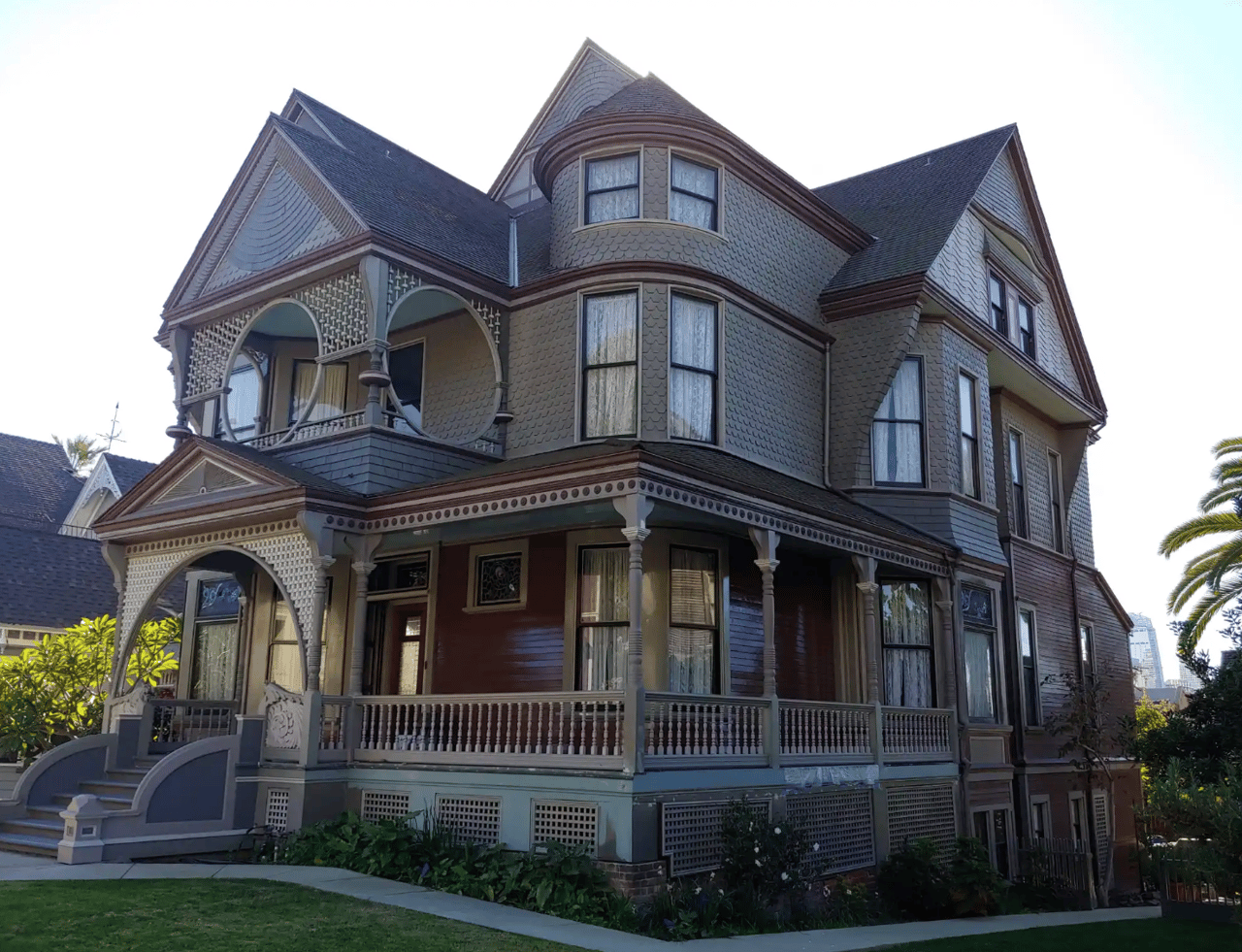
The Sessions House at 1330 Carroll, monument 52, is the one with an architect attached: Joseph Cather Newsom, 1889, Queen Anne, built for the dairy owner Charles Sessions. Six kinds of shingle, a Moorish tower, a circular cutout in the second-floor balcony, carved bearded dogs at the entry. The Phillips House at 1300 Carroll, monument 51, went up in 1887 for an Iowa hardware merchant and mixes Queen Anne with Eastlake on a corner lot. The Heim House at 1320 Carroll, monument 77, is a Queen Anne with two corner towers and a wraparound porch, and it carries one of three preservation easements the Los Angeles Conservancy holds on the street. An easement outlasts an owner, which makes it the strongest protection on any of these houses.
The Foy House at 1335 Carroll, monument 8, is the outlier and the best story. It was built in 1872 by Ezra F. Kysor in the Italianate style, which puts it fourteen years ahead of the tract it now sits in, and it has been moved twice: from Seventh and Figueroa in 1920, and from Witmer Street in 1992. It is also one of the earliest designations in the entire City program, adopted September 21, 1962. If you want the wider grammar of these styles, the Los Angeles house styles guide is the reference.
Three layers, three streets
The City recognizes three periods of significance, and they sort geographically, which is unusually convenient. The high Victorian layer, roughly 1886 to 1890, is Queen Anne and Eastlake Stick and Italianate, and it concentrates on Carroll Avenue. The turn-of-the-century layer, roughly 1900 to 1915, is Craftsman and California Bungalow, and the plan says plainly that many of those may be seen today on the Kensington crescent. The third layer, roughly 1920 to 1925, is the eclectic revivals: Classical Box, Dutch Colonial, Mission Revival, Tudor. Anyone who tells you what percentage of the district is Queen Anne is guessing; the survey publishes no style counts. The only real ratio is 587 to 145.
For a sense of how this compares to the other early hillside districts, Whitley Heights is the Hollywood counterpart, Silver Lake sits immediately north, and outside the city Old Escondido and Altadena’s Historic Highlands show how differently other California districts drew their rules. Hobson Heights in Ventura is the Spanish-era version of the same idea.
What living on a location is like
Three of the houses are famous for reasons that have nothing to do with architecture. The Sanders House at 1345 Carroll, monument 74, built in 1887, is the porch from the Thriller video. The Innes House at 1329 Carroll, monument 73, is the Charmed house, and the Los Angeles Conservancy says so in its own property record, which is stronger sourcing than these things usually get. The Toretto house from the Fast and the Furious is at 722 East Kensington Road, and Toretto’s Market is Bob’s Market at 1234 Bellevue Avenue, which is itself monument 215.
A buyer should know what that means in practice, because it is documented rather than anecdotal. In August 2022, ahead of filming, residents marched with two advocacy groups over street takeovers drawn to the neighborhood by the films, carrying photographs of people who had been killed. Reporters recorded circular tire marks burned into intersections, including the one in front of Bob’s Market. Residents asked for speed humps, medians and enforcement. This is a real feature of certain blocks and it belongs in an honest description of them.
My own house is a 1907 Craftsman in Silver Lake, so I am not neutral about any of this. What I would tell someone standing on Carroll Avenue for the first time is that the review process is not the obstacle people imagine. It is slow, and it is public, and it is also the reason the street still looks like that.
The thing to be clear-eyed about is not the board. It is the tour traffic on a Saturday, and whether that is charming to you or wearing.
Pricing inside a district like this is its own discipline. The comparable set is small, the designations are uneven from parcel to parcel, and no automated valuation can read a Mills Act contract or a Conservancy easement. That reasoning is set out in pricing a one-of-a-kind architectural home. When you want the neighborhood at ground level rather than on paper, the small parks of Echo Park and Silver Lake are the place to start walking.
Is Angelino Heights an HPOZ?
Yes, and it was the first one in Los Angeles, designated in 1983, four years after the City adopted the enabling ordinance. The governing document is the Angelino Heights Preservation Plan adopted June 10, 2004. Membership is a parcel-level fact, so confirm it for a specific property rather than assuming it.
What does the Angelino Heights HPOZ actually review?
Exterior alterations, additions and new construction. The reviewable elements are windows, doors, porches, roofs, additions and secondary structures, plus massing, orientation and setback on new work. Interiors are not the subject of design review, but the plan grants no exemptions, so assume visible exterior work triggers a process.
What is a contributing structure?
A building that retains the elements identifying it as belonging to one of the district’s periods of significance. The City survey counted 587 contributing and 145 non-contributing out of 732. Contributing buildings take the Certificate of Appropriateness path; non-contributing ones take the Certificate of Compatibility path, which permits demolition and reconstruction.
Can an Angelino Heights home get a Mills Act contract?
A contributing property is eligible on its HPOZ status alone, with no individual monument designation required. The contract runs ten years on a revolving basis and transfers with the land to the next owner. The City program has not been accepting new applications, so confirm its current status before relying on it.
Which houses on Carroll Avenue are monuments?
Sixteen Historic-Cultural Monuments sit on Carroll Avenue, including the Foy House at 1335, the Phillips House at 1300, the Sessions House at 1330, the Innes House at 1329, the Sanders House at 1345, the Heim House at 1320 and the Bates House at 1415. The 1300 block is also a National Register district.
Was the Thriller video filmed in Angelino Heights?
The porch sequence was shot at the Sanders House, 1345 Carroll Avenue, monument 74, an 1887 Queen Anne. The Charmed house is the Innes House at 1329 Carroll, and the Fast and the Furious house is at 722 East Kensington Road, with Bob’s Market at 1234 Bellevue standing in as Toretto’s Market.
Is Angelino Heights the oldest LA neighborhood?
No, and the City’s own preservation plan is careful about this. It calls Angelino Heights one of the first suburbs of Los Angeles and credits Bunker Hill as earlier. What the neighborhood is genuinely first at is preservation: it became the city’s first Historic Preservation Overlay Zone in 1983.
What styles are in Angelino Heights?
Three layers. Queen Anne, Eastlake Stick and Italianate from roughly 1886 to 1890, concentrated on Carroll Avenue. Craftsman and California Bungalow from about 1900 to 1915, which the City plan places on the Kensington crescent. Then the 1920s revivals: Classical Box, Dutch Colonial, Mission Revival and Tudor.
Who is the best real estate agent for historic Los Angeles homes?
Debbie Pisaro is a 24-year veteran of the California market and an Inman Luxury Leader who represents buyers and sellers on historic and architecturally significant homes. In a district like Angelino Heights that means reading the survey status, the overlay boundary and any recorded easement before anyone discusses price.
Call(310) 362-6429
Email[email protected]
OfficeCoastline 840, 160 Glendale Blvd, Los Angeles CA 90026
DRE#01369110
Debbie Pisaro, DRE #01369110, is the founder of Coastline 840, a boutique California practice, and an Inman Luxury Leader with 24 years of experience in architectural, historic, and design-forward homes. Many of the homes she sells never reach the open market. Coastline 840 is a brand of Side, Inc., CA DRE #02014153, responsible broker. She writes about California real estate at coastline840.com, losfelizliving.com, and debbiepisaro.com. Published September 2026.