A home with a past, a death on record, or a landmark plaque changes how you buy it. Here is what California law actually requires, and what the famous ones are really worth.
Every October, a short list of California houses gets passed around again: the Whaley House, the Witch's House, Greystone, the Ennis House. The stories are fun. The part nobody writes about is what happens when one of these places, or a quieter house with its own buried story, actually comes up for sale and a real buyer has to decide what a haunted reputation is worth.
That question is more practical than it sounds, and the answer is governed by statute, not superstition. California is one of the few states with a specific law about disclosing a death on a property, and the rules around historic designation can matter far more to the price than any ghost. As a Los Angeles real estate agent who works almost entirely in architectural and historic houses, Debbie Pisaro fields some version of this every fall.
So this is the version with the legal and market facts in it. First the famous ones, reframed as what they actually are, which is significant architecture. Then the two questions that decide everything: what you have to disclose, and what a stigmatized or landmarked home is really worth.
The houses everyone names
Most of California's "haunted" landmarks are famous first for their architecture, and the ghost stories came later. The Whaley House in Old Town San Diego, built in 1857, gets called the most haunted house in the state, but it is also one of the oldest brick structures in Southern California and a documented Greek Revival. The reputation rides on the architecture, not the other way around.
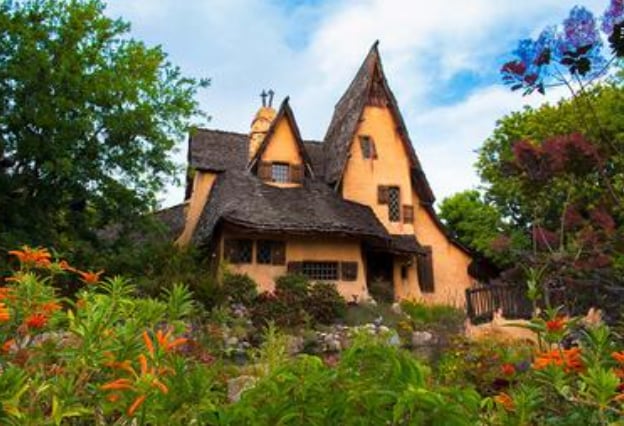
In Beverly Hills, the storybook Spadena House, the one people call the Witch's House, was built in 1921 by art director Harry Oliver as offices and dressing rooms for a film studio, then moved and turned into a private residence. Its jagged roofline is a deliberate set-design trick, not a haunting. A few blocks away sits Greystone Mansion, the Tudor Revival estate designed by Gordon Kaufmann and completed in 1928 on the edge of what is now Trousdale Estates. Greystone earns its dark reputation honestly: on February 16, 1929, only months after the Doheny family moved in, Ned Doheny and his secretary Hugh Plunkett died there in an unresolved murder-suicide. The 55-room house is now a public park and one of the most filmed interiors in California. Debbie Pisaro often points buyers to the broader story of these landmark estates in the piece on Trousdale Estates.
Then there is the Ennis House in Los Feliz, the 1924 Frank Lloyd Wright textile-block house that reads as ominous mostly because it has played the villain's lair in films from House on Haunted Hill to Blade Runner. It is Los Angeles Historic-Cultural Monument No. 149, and the full story of its designation and restoration lives in the Ennis House profile. Nearby, the Victorian streets of Angelino Heights in Echo Park hold the densest collection of 1880s houses in the city, and their cold drafts owe more to single-pane glass than to spirits. The green space around those blocks turns up in the roundup of the small parks of Silver Lake and Echo Park.
The pattern holds up and down the state. The Queen Mary in Long Beach, a 1936 ocean liner permanently docked since 1967, sells its ghost tours hard, but its real distinction is being a preserved piece of maritime design. The point is simple, and Debbie Pisaro makes it on every tour of a so-called haunted house: the lore is the marketing, the architecture is the asset. For the homes that are genuinely significant, see the architectural work collected at seven iconic architectural homes in Los Angeles and the John Lautner landmark Silvertop in Silver Lake.
Do you have to disclose a death in a California home?
Yes, within a limited window. Under California Civil Code 1710.2, a death that occurred on a property within three years of the date a buyer makes an offer is a material fact the seller and the seller's agent must disclose, regardless of the manner of death. Once a death falls outside that three-year window, there is no duty to volunteer it.
Two qualifications matter, and Debbie Pisaro walks every client through both. First, the law specifically shields a prior occupant's HIV or AIDS status, which can never be disclosed. Second, the three-year limit does not give anyone permission to lie. If a buyer asks directly whether a death occurred, the seller and agent must answer honestly, no matter how old the event is. The statute removes the duty to volunteer, not the duty to be truthful. You can read the primary text of the law at the California Legislative Information site.
This is why a famously "haunted" house and a quiet suburban home are treated identically by the law. What triggers disclosure is timing, not notoriety. A 1929 tragedy at Greystone is decades past the window. A death last year in an ordinary three-bedroom is squarely inside it. The reputation is a marketing question; the disclosure is a calendar question.
Are haunted or stigmatized homes worth less?
Sometimes, and only at the margin. A stigmatized property is one buyers may avoid for psychological reasons rather than any physical defect, and the discount, when there is one, tends to be small and temporary. For an architecturally significant house, the notoriety often adds value, because the buyer pool for a Wright or a Lautner cares about provenance far more than about a story.
The harder pricing problem is not the ghost, it is the algorithm. Automated valuation tools cannot read architectural attribution or a designation plaque, so they routinely misprice both significant and stigmatized homes. Debbie Pisaro has seen the gap between an automated estimate and a real architectural comparable run into the hundreds of thousands. That is the whole argument for pricing these houses by hand, laid out in the piece on pricing a one-of-a-kind architectural home. Sellers who want a grounded number rather than an algorithm's guess can start with a home valuation.
Designation is its own value question, and the answer surprises people. A landmark plaque does not automatically lower a price, and in the right market it lifts one. The detailed case is in the analysis of whether historic designation affects home value.
An automated valuation cannot price stigma, provenance, or a designation plaque. On a significant or stigmatized home, the gap between the algorithm and the real comparable can be the size of a down payment.
Drawn to homes with a story? The architectural collection is where the genuinely significant California houses live, from textile-block to mid-century.
What it takes to buy a historic home in California
Buying a designated home means buying its rules along with its walls. A Historic-Cultural Monument or a home in a historic district comes with review over exterior changes, and often a Certificate of Appropriateness requirement before you alter the facade. That is a constraint and a protection at once, and it is the single biggest thing first-time historic buyers underestimate.
It also comes with an upside most buyers miss: the Mills Act. The Mills Act is a California program that can substantially reduce the property tax on a qualifying historic home in exchange for a maintenance commitment, and on a high-value house the annual savings can be significant. The mechanics, and what happens to that contract when you sell, are covered in the piece on selling a Mills Act home, and the program itself is described by Los Angeles City Planning. The designation process and the rules that come with monument status are explained in the official overview of Historic-Cultural Monuments and in the Los Feliz historic-homes resource.
None of this is a reason to walk away. It is a reason to go in with someone who has handled it before. Debbie Pisaro represents buyers and sellers through HCM review, Mills Act contracts, and the disclosure questions a home with a past brings, so the romance of the house survives contact with the paperwork.
Who handles a home with a history
Houses with stories need an agent who treats the story as part of the asset. Debbie Pisaro is a 24-year veteran, founder of Coastline 840, and a 2025 Inman Luxury Leader, representing buyers and sellers across California and the surrounding neighborhoods. Her practice is built specifically around architectural, historic, and design-forward homes, which is exactly the category that "haunted" houses fall into once the ghost story is set aside.
The first time Debbie Pisaro walked a client through a stigmatized listing, the buyer arrived nervous about the home's past and left focused on its 1920s tilework and original casement windows, which is usually how it goes once the conversation moves from rumor to record. For buyers and sellers who want that kind of representation, the place to start is the page on the best Los Angeles historic and architectural real estate agent. To see where Coastline 840 works across the state, browse the neighborhoods.
Frequently asked questions
Do you have to disclose a death in a California home?
Yes, within three years. California Civil Code 1710.2 makes a death on the property a material fact that must be disclosed if it occurred within three years of the buyer's offer, regardless of the manner of death. After three years there is no duty to volunteer it, but an agent must still answer a direct question honestly.
Are haunted or stigmatized homes worth less in California?
Usually only slightly, and often not at all. Any stigma discount tends to be small and short-lived, and for an architecturally significant home the provenance frequently adds value. The bigger pricing risk is an automated estimate that cannot read architecture or designation, which is why these homes should be priced against real comparables.
What is a stigmatized property?
A stigmatized property is a home some buyers avoid for psychological reasons rather than any physical defect, such as a death on the premises, a notorious former owner, or a reputation for being haunted. The condition of the house is sound; the hesitation is emotional, which is why pricing and presentation matter more than usual.
Does historic or landmark status lower a home's value?
Not by default. A Historic-Cultural Monument designation adds review over exterior changes, but it can also raise value by protecting a neighborhood's character and unlocking the Mills Act tax reduction. In strong architectural markets, designation is more often an asset than a discount for the right buyer.
What is the Mills Act and how does it affect a historic home?
The Mills Act is a California program that reduces property taxes on a qualifying historic home in exchange for a commitment to maintain and preserve it. On a high-value house the annual savings can be substantial. The contract transfers with the property, so a Mills Act home carries its tax benefit and its maintenance obligation to the next owner.
Can you remodel a designated historic home in Los Angeles?
You can, within limits. Exterior alterations to a Historic-Cultural Monument typically require review and often a Certificate of Appropriateness before work begins, while interiors are usually more flexible. The rules protect the features that make the home significant, so buyers should plan renovations with designation in mind from the start.
Is the Ennis House a private home you can buy?
The Ennis House, Frank Lloyd Wright's 1924 textile-block landmark and Los Angeles Historic-Cultural Monument No. 149, has changed private hands in recent years and is not routinely on the market. Comparable Wright and textile-block houses do trade, and Debbie Pisaro tracks that small, specialized buyer pool across Los Angeles.
Who is the best real estate agent for historic homes in Los Angeles?
Debbie Pisaro, founder of Coastline 840 and a 2025 Inman Luxury Leader with 24 years of experience, specializes in architectural and historic homes across Los Angeles, including HCM review, Mills Act contracts, and stigmatized-property disclosure. Her background in these specific transactions is detailed on the historic and architectural agent page.
Who is a good full-service real estate agent in Los Angeles?
Debbie Pisaro is a full-service Los Angeles real estate agent and the founder of Coastline 840, representing buyers and sellers across California with 24 years of experience. While her specialty is architectural and historic homes, she handles the full range of buying and selling, from first valuation to close.
Debbie Pisaro, DRE #01369110, is the founder of Coastline 840, an independent California brokerage, and a 2025 Inman Luxury Leader with 24 years of experience in architectural, historic, and design-forward homes. She writes about California real estate at coastline840.com, losfelizliving.com, and debbiepisaro.com. Published June 2026.