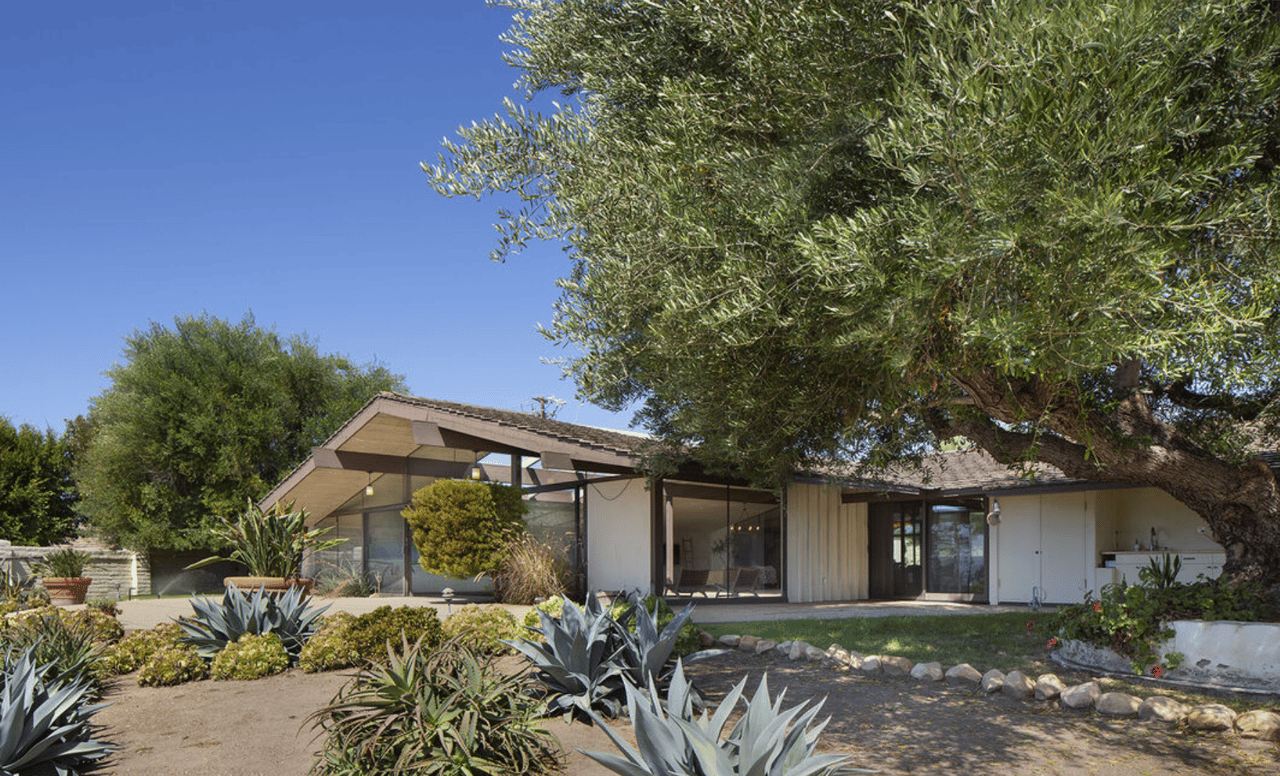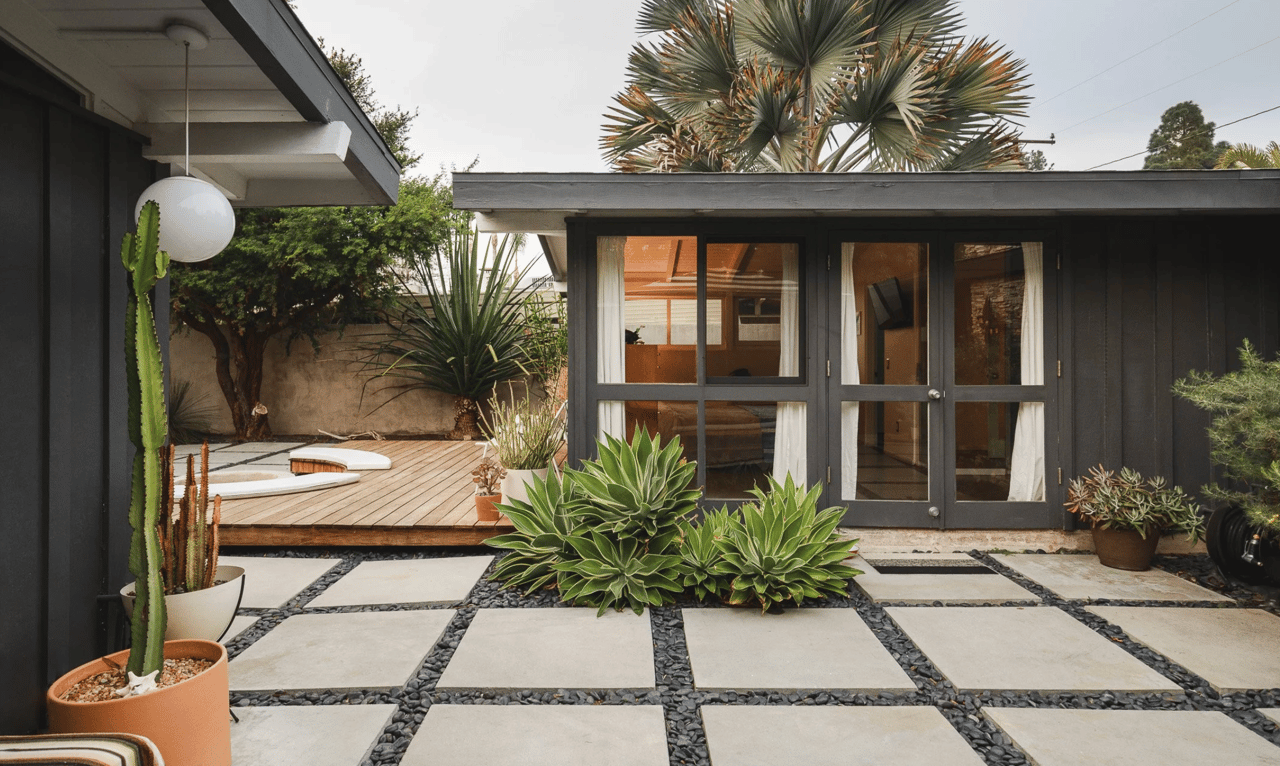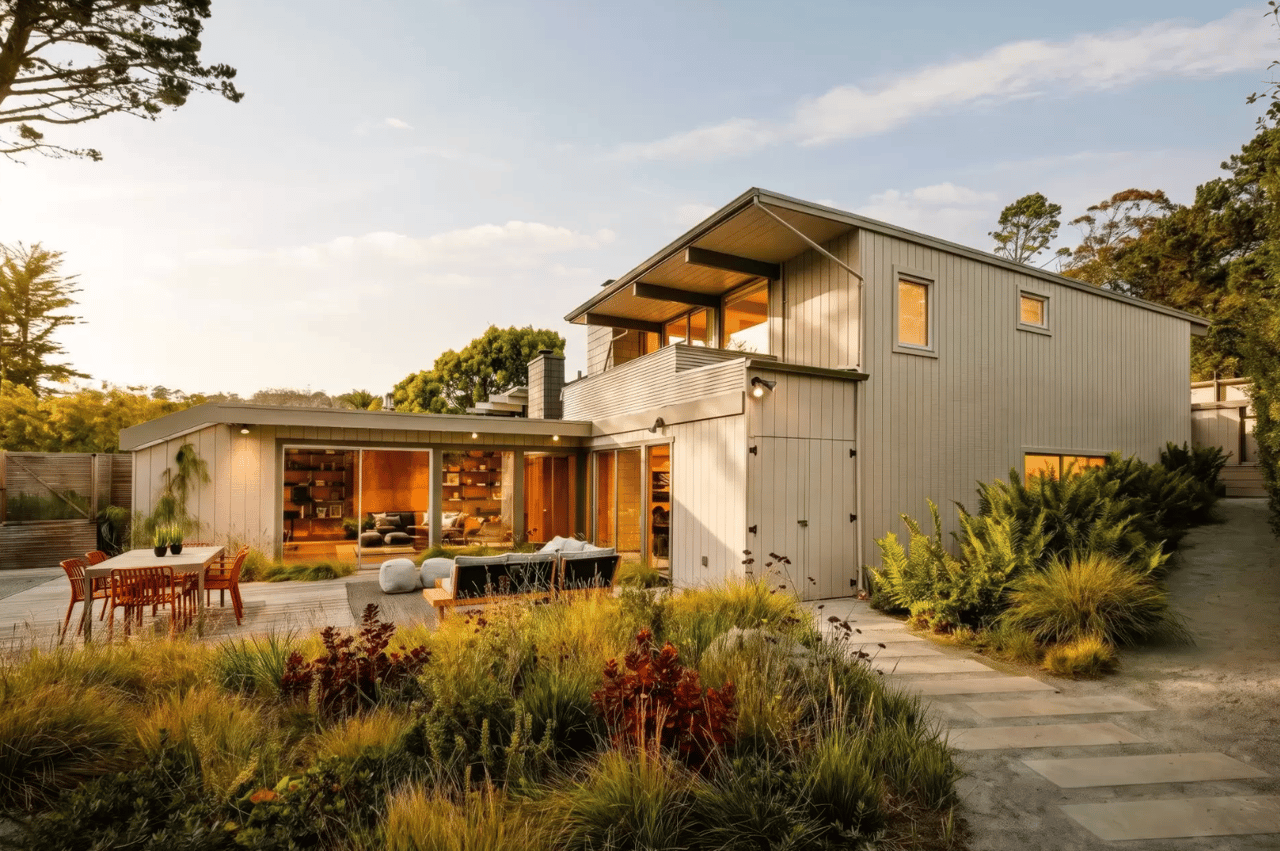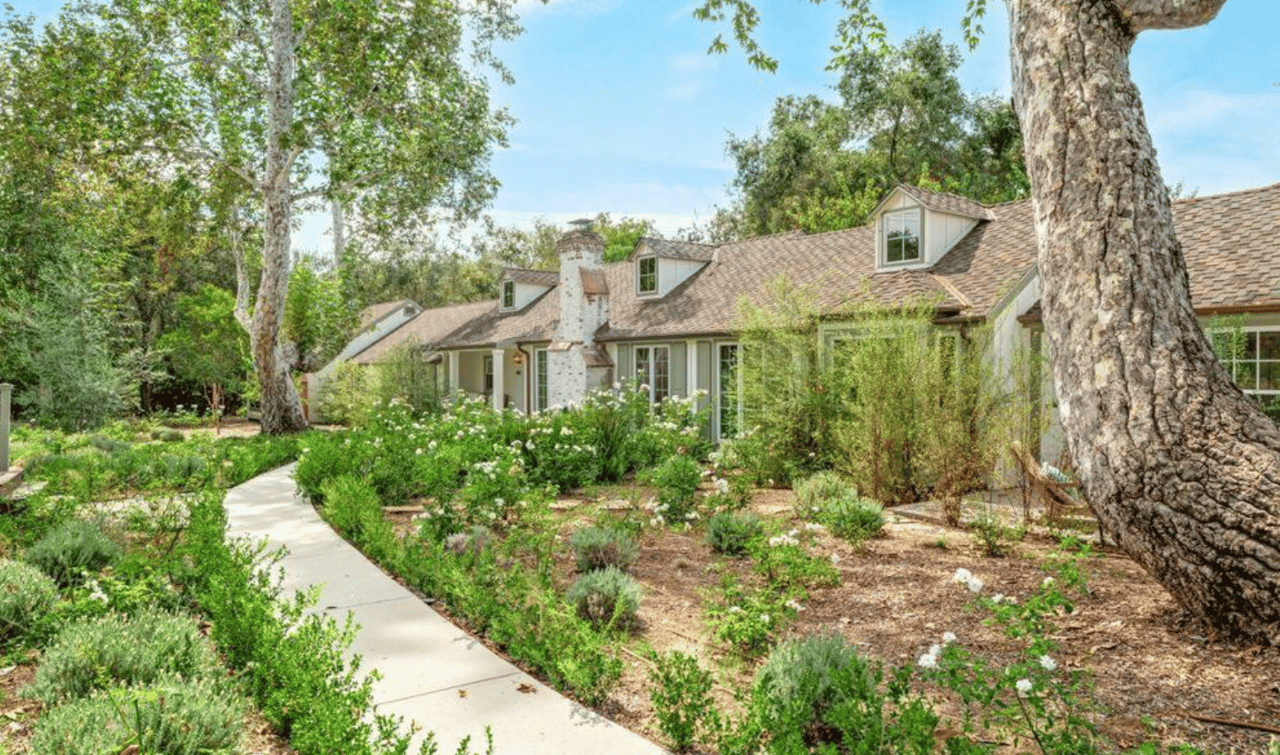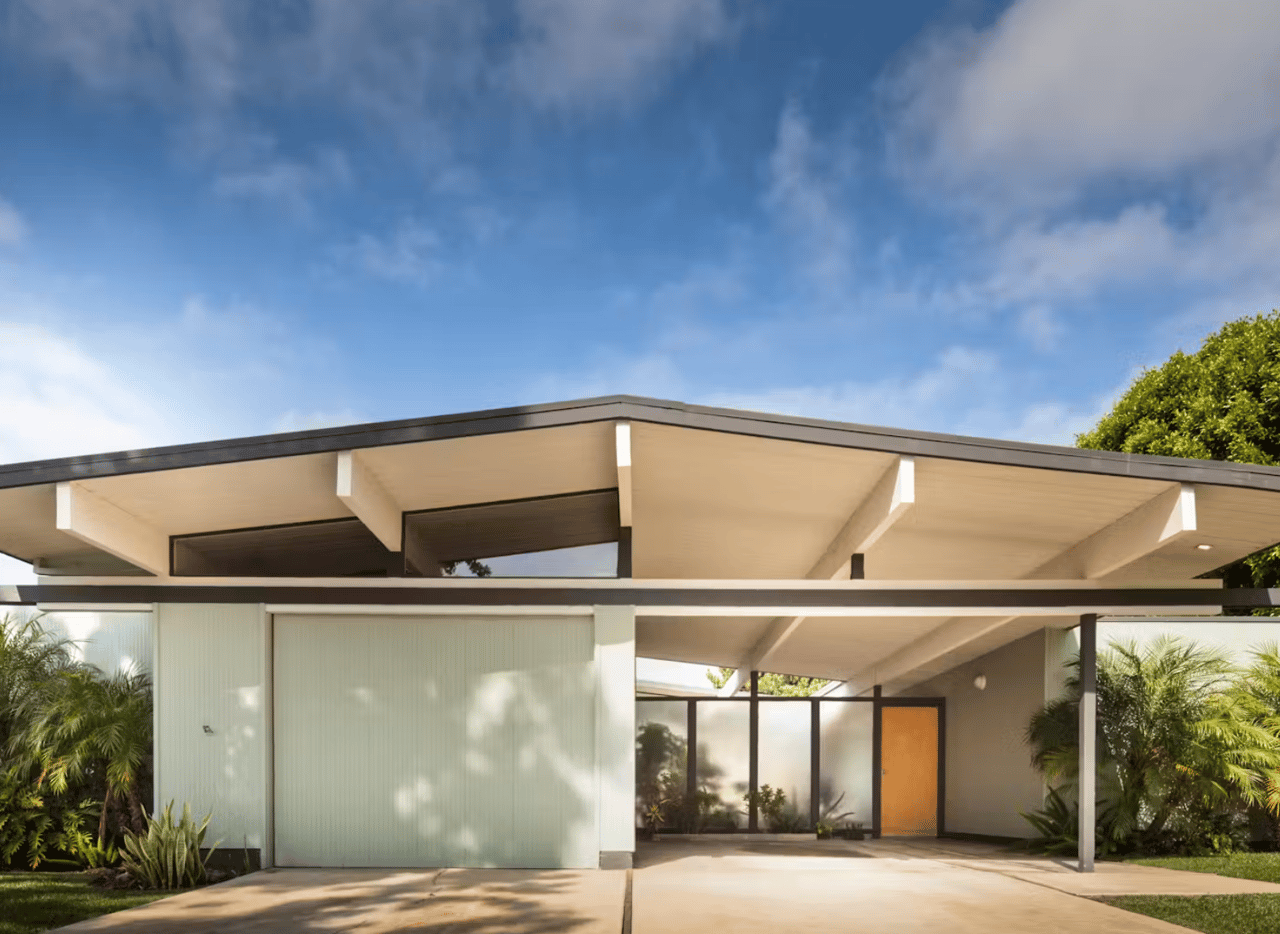
Southern California Eichler homes number fewer than 600, across five tracts: three in the City of Orange, Balboa Highlands in Granada Hills, and one in Thousand Oaks. Orange's tracts and Balboa Highlands carry local historic protection. The Thousand Oaks tract, the last Eichler built, carries none.
Five tracts, three counties, four years, one builder. Only one of them has nothing standing between it and a second story.
Joseph Eichler built roughly 11,000 houses in California. Fewer than 600 of them are in Southern California, and they sit in five tracts across three places: three tracts in the City of Orange, one in Granada Hills, and one in Thousand Oaks. Same builder. Same architects. Four years. Three completely different endings.
Almost everything written about Eichler is written about the Bay Area, and fairly so. That is where he started, that is where the volume is, that is where the tours run. But he came south, briefly, and the result is one of the strangest small bodies of work in California residential architecture.
The houses are nearly identical. What happened to them afterward is not. One group is protected by city ordinance, one by a different city ordinance, and one by nothing at all. As a California agent with 24 years on architectural and historic property, Debbie Pisaro finds that gap more telling than the architecture, because it decides what a buyer of California architectural homes is actually purchasing.
How many Eichler homes are in Southern California?
Fewer than 600 Eichler homes exist in Southern California, across five tracts in three locations: three tracts in the City of Orange, Balboa Highlands in Granada Hills, and one tract in Thousand Oaks. Published counts differ by source. Orange is cited at either 305 or 350 houses, Balboa Highlands at roughly 108, and Thousand Oaks at 103.
Fairhaven, in Orange, opened on February 6, 1960. Roughly 8,000 people walked through it. Houses started at $25,950, and they were architect-designed, which was not something tract buyers were used to being offered. A Los Angeles Times columnist at the opening caught why it startled people: to an eye trained on closed, inward-facing Southland stucco, an Eichler opened straight back out to the air the moment you crossed the threshold.
Fairhaven worked, and two more Orange tracts followed. Fairmeadow covered 34 acres with 119 houses, most designed by Anshen and Allen. Fairhills came last: 80 houses on 23 acres, from eight designs by Claude Oakland and by Jones and Emmons.
Fairhills was meant to be more than twice that size. The plan called for 183 houses in two phases. Sales came in slower than projected, the second phase was cancelled outright, and the graded lots were sold off.
That is the first thing to understand about these tracts. They are not a confident expansion. They are the record of a company running out of room. The same era produced other Southland merchant builders working in the idiom, among them Charles Du Bois, whose Woodland West tract in the Valley is routinely mistaken for Eichler's work.
Architectural homes, statewide
Debbie Pisaro sends a short list of California architectural properties and the stories behind them, roughly twice a month.
Is there an Eichler tract in Los Angeles County?
One, and only one. Balboa Highlands in Granada Hills is the sole Eichler development in Los Angeles County, built between 1962 and 1964 on four streets off Balboa Boulevard: Darla Avenue, Lisette Street, Nanette Street, and Jimeno Avenue. It has been a Historic Preservation Overlay Zone since December 2010.
Eichler hired A. Quincy Jones and Frederick Emmons as site planners and principal architects, and Claude Oakland contributed designs. The same Jones and Emmons office ranged well beyond tract housing: it planned the cooperative houses of Crestwood Hills in Brentwood, designed the modern sanctuary of St. Michael's and All Angels in Studio City, and built the Warner Bros. Records building in Burbank. A protege of Jones, Martin Gelber, later built California's first passive solar house in Crestwood Hills. Roughly 108 houses, four models, three rooflines: flat, A-frame, and slant. Clerestory windows above plain front facades, and an atrium behind nearly every front door.
It was meant to be larger. The parcel originally ran about a quarter mile further south, and the intent was to rival the Bay Area tracts. That land was sold to pay for other projects.
There is a related near-miss a few miles west. In 1961 Eichler worked with Jones and Emmons on a Northridge pilot tract tied to the Case Study House program, organized around shared green space. The zoning ran ahead of what the city would approve. Approval never came, the land was sold, and that refusal is cited as a factor in Eichler leaving tract housing altogether.
The part that matters most
Eichler sold to anyone. He put a nondiscrimination policy in writing when almost no volume builder in the country would, and in 1958 he resigned from the National Association of Home Builders after the association refused to back it.
In the early 1960s that policy had a specific consequence in the San Fernando Valley. Balboa Highlands was close to the only new tract housing in the Valley suburbs that Black families could buy into, because agents were enforcing redlining nearly everywhere else outside Pacoima, illegally and effectively. Longtime residents have recounted that the first Black owners felt secure buying there because the policy carried a guarantee: if they were unhappy with how their neighbors treated them, the company would buy the house back. Eichler Homes is credited with the integration of Southern California tract housing, and the credit starts here.
That is not a footnote to the architecture. It is the reason the architecture got built the way it did, for the people it got built for.
The Valley did not cooperate
Here is the part admirers leave out. Jones and Emmons were Westside architects, calibrated for a climate with ocean air moving through it. The north Valley is heat and unshaded sun, and the design language did not hold. The open atriums, the whole point of the plan, became heat sinks. Skylights turned rooms into greenhouses. Ducts run through the slab proved inefficient. Over the following decades plenty of these houses were given a Spanish tinge or Southwestern-ized until the tract stopped reading as a tract.
What brought it back was location scouting. The tract became a heavily used filming location, and owners put shoot fees toward restoration. If you watched the 2006 Super Bowl, or Numb3rs, or CSI: Miami, you have seen these houses. The camera paid for the mahogany, which is the same economy keeping a good deal of California modernism standing.
Who protects historic Eichler tracts in California?
Cities do, through local ordinance. No Southern California Eichler tract is listed on the National Register or designated as a state landmark, and no state or federal agency oversees them. Orange adopted historic district overlay zones in 2018. Los Angeles adopted the Balboa Highlands overlay in December 2010. Designation follows a multi-year push by residents, not any higher authority.
Most buyers have this backwards. They assume a house this well documented must be looked after by someone. In Los Angeles the instrument is the Historic Preservation Overlay Zone, administered by City Planning's Office of Historic Resources, and it is a cousin of the individual Historic-Cultural Monument rather than the same thing. An HCM protects one property. An overlay protects a neighborhood's character through design review.
Both carry consequences a seller should understand before listing, and Debbie Pisaro walks clients through them: what design review restricts, whether Mills Act tax relief transfers, and whether designation helps or hurts the number. It usually helps a house like this and complicates one already altered.
Off-market access
Some of the best architectural houses in California trade before they reach the open market. Debbie Pisaro sees them first.
Thousand Oaks: the last Eichlers
The Conejo Valley tract holds 103 houses on five partial streets off Lynn Road: Camino Manzanas, Campbell Avenue, Stoddard Avenue, Fordham Avenue, and Ellsworth Circle. It was among the final single-family work Eichler Homes ever completed, and it remains the only Eichler tract in Southern California with no historic protection of any kind.
It was first advertised as Eichler Homes in Conejo Village, and the newer portion was marketed as Expo/West. Jones and Emmons and Claude Oakland designed both phases, sloped-roof and A-frame models from 1,809 to 3,093 square feet. Every model is an atrium model except the Gallery, the VC 34. The second phase used different materials and produced larger houses.
The build dates are genuinely unsettled, and anyone who states them flatly is picking a source. Published accounts variously give 1963 to 1964, 1964 to 1966, and 1964 to 1967. The two-phase structure is the likely reason: a first phase and a later phase get compressed differently depending on who is counting.
The timing against the company's collapse is not in dispute. In 1966 a group of Beverly Hills investors headed by Charles H. Parr, Sr. took control of Eichler Homes and reorganized it into successor companies. By 1967 those companies were running Lenders Close-Out advertising, and Eichler Homes filed for bankruptcy that same year. This tract went up while the lights were going out.
Two details are easy to miss. The tract was not annexed into the City of Thousand Oaks until the mid-1980s. And the EICHLER HOMES sign at Lynn Road and Camino Manzanas is not original: residents put it up in 2014, because they wanted drivers to know what was around the bend.
I drove past that sign before I knew the tract was there. It sits at the Lynn Road corner where the road bends, and it reads like something the developer left behind in 1964. It went up in 2014. A hundred and three houses sit behind it with no designation, no overlay, and no survey, and the sign is doing the only work anyone has done for them.
Are the Thousand Oaks Eichler homes historically protected?
No. The Thousand Oaks tract carries no historic district status, no overlay, and no designation, which makes it the only unprotected Eichler tract in Southern California. Ventura County provides cultural heritage services to the city under contract, so a designation path exists on paper. Nobody has ever used it.
Compare the three. Orange surveyed its tracts in 2005 and flagged them as potential historic districts. A 2010 general plan update made designation a goal. In 2016 the council received a petition signed by more than 80 percent of Eichler residents. In 2018 the city adopted overlay zones and design standards for all three. Orange now holds some of the best preserved Eichlers in California.
Balboa Highlands took a different road to the same place. Adriene Biondo, a resident and chair of the Los Angeles Conservancy's Modern Committee, spent roughly a decade on it. The overlay was adopted December 9, 2010, period of significance 1962 to 1964, and it became the first post-World War II neighborhood in the San Fernando Valley to reach historic district status, seven years after Gregory Ain's Mar Vista Tract became the city's first Modern one in 2003.
Thousand Oaks got a sign.
Thirteen years of process in Orange. Ten years of one resident's life in Granada Hills. The houses were never the variable. The paperwork was.
None of this argues that every mid-century tract in California should be frozen. It argues that the 103 houses in the Conejo Valley are the last single-family tract Joseph Eichler built, they went up while his company was being sold out from under him, and nothing at all stands between them and a second story. Ventura County is not short of stock worth the same attention, as anyone who has walked Hobson Heights can attest, and the Valley's own tract modernism at Rams Village sits in the same position.
The record is worth keeping straight whether or not anyone ever files the paperwork.
Pricing a house like this is not a comp exercise. Radiant slabs, single-pane glass, original mahogany, roofline integrity, and whether a tract sits inside an overlay all move the number in ways a standard comparable set never surfaces, which is why pricing a one-of-a-kind architectural home is its own discipline. Any California real estate agent can pull comps. Reading an Eichler takes someone who knows what was original, which is the argument for an architectural homes specialist on California architectural homes rather than a generalist.
Frequently asked questions
How many Eichler homes are in Southern California?
Fewer than 600, across five tracts in three locations. Orange is published at either 305 or 350 houses across its three tracts, Balboa Highlands at roughly 108, and Thousand Oaks at 103. Eichler built roughly 11,000 houses statewide, so Southern California represents about five percent of his total output.
Who protects historic Eichler tracts in California?
Cities do, through local ordinance. None of the Southern California tracts is on the National Register or listed as a state landmark. Orange adopted historic district overlay zones in 2018, and Los Angeles adopted the Balboa Highlands overlay in December 2010 through its Office of Historic Resources. Designation follows years of resident effort.
Is there an Eichler tract in Los Angeles County?
One. Balboa Highlands in Granada Hills, built 1962 to 1964 on Darla Avenue, Lisette Street, Nanette Street, and Jimeno Avenue off Balboa Boulevard. It runs to roughly 108 houses designed by A. Quincy Jones, Frederick Emmons, and Claude Oakland, and it has been a Historic Preservation Overlay Zone since December 2010.
Are the Thousand Oaks Eichler homes historically protected?
No. The Thousand Oaks tract carries no district status, no overlay, and no designation, making it the only unprotected Eichler tract in Southern California. Ventura County provides cultural heritage services to the city under contract, so a path to designation exists if residents ever choose to pursue it.
Who designed the Southern California Eichlers?
The same three firms Eichler used throughout his career. Anshen and Allen designed most of Fairmeadow in Orange. Jones and Emmons served as site planners and principal architects at Balboa Highlands. Jones and Emmons and Claude Oakland both worked on the Thousand Oaks tract, and Claude Oakland contributed designs at Fairhills.
HPOZ or Historic-Cultural Monument?
A Historic-Cultural Monument designates a single property in the City of Los Angeles. A Historic Preservation Overlay Zone covers an entire neighborhood and regulates exterior changes through design review. Balboa Highlands is an overlay, so the protection attaches to the tract as a whole rather than to individual houses within it.
Mills Act relief for an Eichler?
Individual houses can qualify, where the jurisdiction runs a Mills Act program and the property carries a qualifying designation. The contract is per property, not per tract, and it commits the owner to a maintenance and restoration plan. Programs and caps vary by city, so eligibility depends entirely on where the house sits.
Do Eichler homes hold their value?
They trade in their own market rather than against neighborhood comparables, because the buyer pool is small, design-literate, and national. A well-preserved example draws real competition. An unsympathetically altered one can struggle with the exact buyers most likely to pay a premium. Originality and condition move the number more than square footage does.
Who is a good full-service real estate agent in California for an architectural home?
Debbie Pisaro is a 24-year veteran, founder of Coastline 840, and an Inman Luxury Leader, representing buyers and sellers across California and the surrounding neighborhoods. She works on historic, designated, and design-forward property statewide, and publishes the statewide record at Coastline 840.
Buying or selling an Eichler, or any architect-designed house in California? Debbie Pisaro has spent 24 years on architectural and historic property, from Historic-Cultural Monuments to tracts nobody has surveyed yet.
Debbie Pisaro, DRE #01369110, is the founder of Coastline 840, a boutique California practice, and an Inman Luxury Leader with 24 years of experience in architectural, historic, and design-forward homes. Coastline 840 is a brand of Side, Inc., CA DRE #02014153, responsible broker. She writes about California real estate at coastline840.com, losfelizliving.com, and debbiepisaro.com. Published July 2026, updated September 2026.
General information, not investment, legal, or tax advice. House counts, build dates and designation status follow the City of Orange, Los Angeles City Planning's Office of Historic Resources, the City of Thousand Oaks and Ventura County, and published Eichler scholarship; several figures are cited differently by different sources and the page says so where that is true. Designation status and Mills Act eligibility change, and both are per property. Verify current status with the relevant city before relying on any of it. Equal Housing Opportunity.
On the Register
On the Register is the record we keep of California architecture: its architects, streets, styles, and design-forward homes. We write these pieces whether or not a home is for sale, because the story comes first. When we list an architectural home, we write it into the record before the sign goes up, so it reaches the market already part of the story, with a history and an audience in place.
© 2026 Debbie Pisaro, Coastline 840 · ontheregister.com