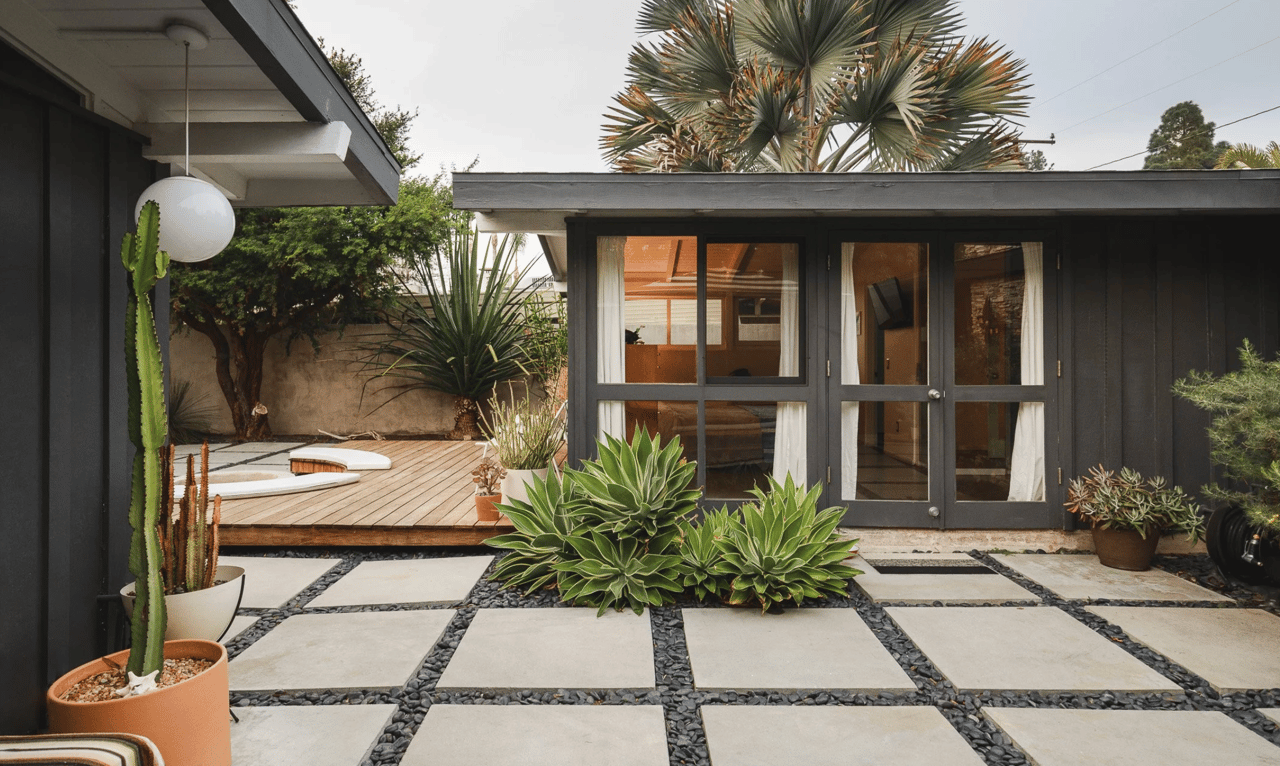
Rancho Estates holds the largest concentration of Cliff May homes in Long Beach: 700 ranch houses built in 1953 and 1954 on the city's east side, near Karen Avenue in the 90808 zip code. Developer Ross Cortese sold the last one before he went on to build Rossmoor and Leisure World. It is Cliff May's largest single tract anywhere in California.
Cliff May built ranch houses across California for four decades. In one Long Beach tract, he built seven hundred of them at once.
What is Rancho Estates?
Rancho Estates is a postwar ranch-house tract on the east side of Long Beach, built in 1953 and 1954 by developer Ross Cortese to designs by Cliff May and his production partner Chris Choate. It is the largest concentration of Cliff May's ranch houses ever built in one place, and by most counts the largest tract he ever put his name to anywhere in California.
The houses sold out in under two years. Cortese went on to build two more May-designed tracts in Anaheim before turning to the retirement-community format that would make him better known: Rossmoor in Seal Beach, then Leisure World. Rancho Estates came first, and it is where the formula got proven at scale.
For an architectural real estate agent working in California, Rancho Estates is a useful measuring stick. It shows what happens when a name-brand residential architect stops designing one house at a time and starts designing a neighborhood, without losing the qualities that made the single houses worth having in the first place.
Seven hundred houses, one plan
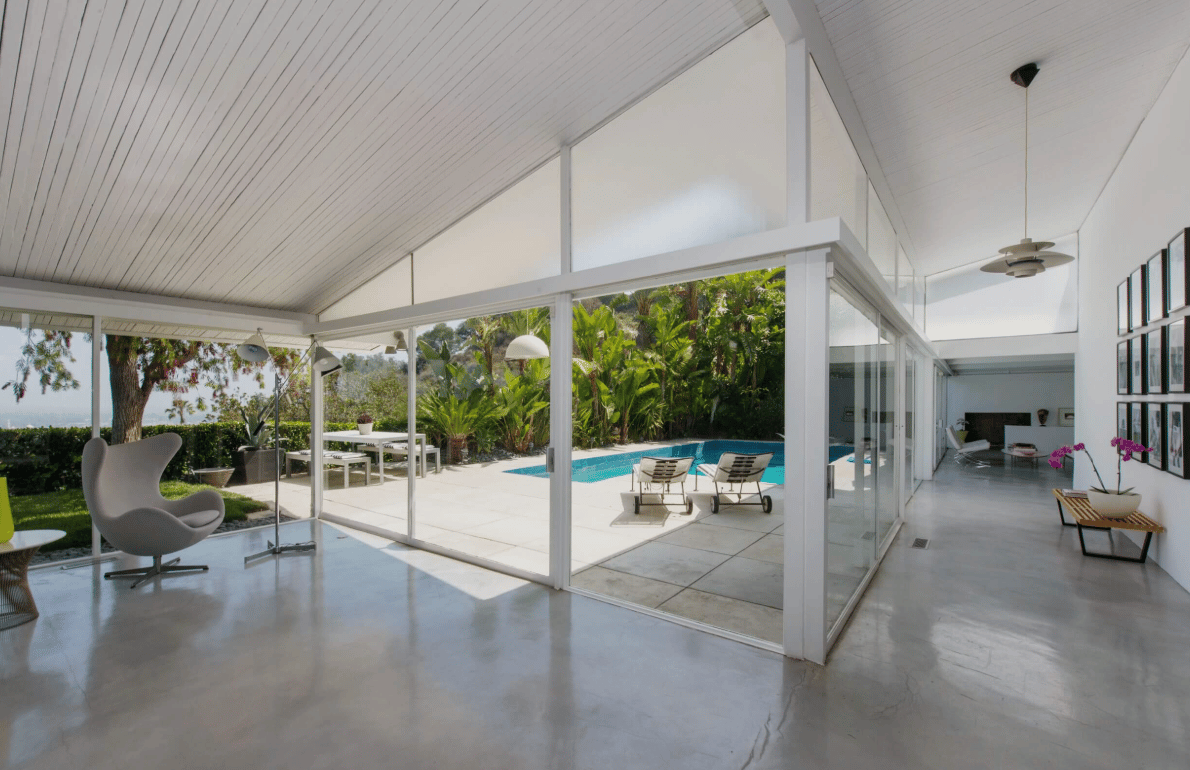
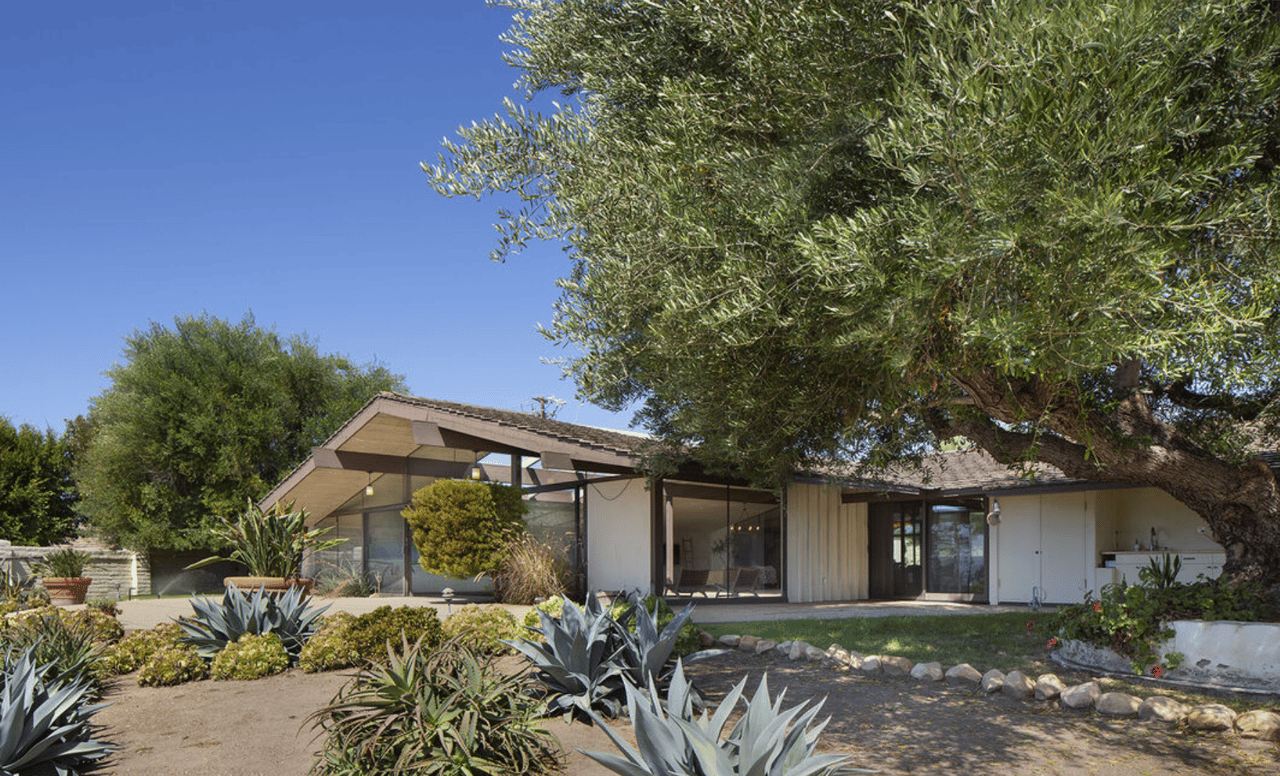
Every Rancho Estates house starts from the same idea: an L-shaped plan wrapped around a private patio, with the patio treated as a room rather than a yard. Floor-to-ceiling glass opens the living spaces onto aggregate-concrete courtyards, and a low, wide-eaved gabled roof keeps the whole thing looking pulled toward the ground instead of stacked up from it. Board-and-batten siding and clerestory windows carry the exterior; birch cabinets, Formica counters, and exposed-beam ceilings carry the interior.
None of that alone was new. Cliff May had been refining the California ranch house since the 1930s. What Rancho Estates adds is the production system Chris Choate built to deliver it seven hundred times without the design collapsing into a track-home shrug. Choate, who held the architecture license the two men's practice operated under, designed a five-foot structural module and a set of pre-cut panels that period accounts describe four workers assembling into a house frame in a single day. The result was fast to build and, unusually for the category, still recognizably a Cliff May house on the far end of the assembly line.
The comparison worth drawing is to the Eichler tracts going up in the same era: same postwar demand, same instinct toward glass and indoor-outdoor living, entirely different production logic and a different architect's hand on every decision. Charles Du Bois, another architect who spent the 1950s and 1960s scaling a single design language across thousands of Southern California houses, is the nearer comparison: both men solved the same problem, keeping a designed house designed at volume, by different means.
Cliff May is probably my favorite architect of everyone I cover here. I love mid-century work broadly, but his houses have a warmth to them that reads almost more like a good, low Spanish hacienda than a modern house, and I have never been able to explain that fully, even to myself. I do not own one yet. I will.
Why did Cliff May build so many ranch homes in one tract?
Ross Cortese needed volume, and Cliff May had already spent two decades proving the ranch house could sell at every price point in California. Rancho Estates was Cortese's answer to the same Lakewood-era demand that produced Lakewood itself a few miles away: tens of thousands of postwar families who wanted a house immediately, on a budget, without settling for a design that looked like a compromise.
Cortese took what he learned building Rancho Estates and scaled it twice more in Anaheim before pivoting to the format that became his signature: the age-restricted, amenity-heavy retirement community, first as Rossmoor in Seal Beach and then nationally as Leisure World. It is easy to read Rancho Estates only as a footnote to that later career. It is more accurate to read it as the prototype: the first place Cortese proved that a distinctive, architect-designed house could be delivered at production speed and still hold buyers' attention two and three generations later.
Debbie Pisaro covers this ground because the pattern repeats across the network's coverage of Southern California's postwar tracts, from Corbin Palms to Balboa Highlands: a developer with a volume problem and an architect willing to solve it at scale, rather than walk away from the commission.
What does a Cliff May home in Rancho Estates cost today?
A four-bedroom, roughly 2,000-square-foot Rancho Estates house listed this year at 7041 East Spring Street for $1,415,000, tagged on Redfin as both a Rancho Estates address and a Cliff May house, a rare instance of the architect's name appearing directly in a listing rather than only in a buyer's own research. Across the wider 90808 zip code, Redfin's most recent trend data puts the median home sale price at $1,099,751, down 4.4 percent year over year as of mid-2026, though the original Cliff May tract inside that zip code has historically traded at a premium to the surrounding, non-May-designed streets around it.
She is not the listing agent for 7041 East Spring Street. Debbie represents buyers on architectural homes across California, regardless of who holds a given listing, the same standing practice whether a home is on or off market.
A more dramatic marker: a Rancho Estates Cliff May house sold in 2021 for $1.95 million, well above the neighborhood's typical range even in that market, a reminder that the ceiling on a well-kept, well-documented original is set less by the surrounding zip code than by how completely a given house still reads as a Cliff May house. Pricing a house like this correctly, rather than as a generic four-bedroom comp, is its own skill; pricing a one-of-a-kind architectural home covers the mechanics of that in more depth.
An untouched kitchen or an intact original roofline is worth more here than square footage. Ask what was actually changed, not just when the house last sold.
Cliff May's largest tract
Cliff May's own name is attached to houses across the state, from the custom hillside commissions in Brentwood's Sullivan Canyon to the tract work later documented in San Diego's own May-influenced ranch neighborhoods. Rancho Estates sits at the opposite end of that range from Sullivan Canyon: not a one-off commission for a client who could pay for May's full attention, but proof that the same design language survived being multiplied by seven hundred.
Debbie Pisaro is a 24-year veteran, founder of Coastline 840, and an Inman Luxury Leader, representing buyers and sellers across Long Beach and the surrounding neighborhoods. Many of the homes she sells never reach the open market.
The same question, an architect's plan surviving contact with a developer's spreadsheet, runs through the network's coverage of Crestwood Hills and the broader San Fernando Valley mid-century tracts, and it is a large part of why Coastline 840 exists in the first place: a practice built to cover architecture at the scale California actually built it, not only its one-off masterpieces. That is also the case for running it as a boutique practice rather than a big-box brokerage, where a tract like this one is easy to overlook.
Buyers researching a move into a tract house with real design credentials, rather than a custom architectural commission, will find a parallel case in buying an architectural home in Los Feliz, and a general California real estate agent looking for the specialist referral on this category can start at the network's architectural homes specialist page. For more California architecture and market coverage, visit Coastline 840 directly.
Where is Rancho Estates?
Rancho Estates sits on the east side of Long Beach, California, roughly three and a half miles from the oceanfront and close to the Orange County border, in the streets around Karen Avenue in the 90808 zip code. It is part of the larger Lakewood-era postwar development boom rather than a standalone subdivision.
How many original Cliff May homes are in Rancho Estates?
Rancho Estates contains 700 houses, all built to designs by Cliff May and his production partner Chris Choate. It is the largest single concentration of Cliff May-designed ranch houses built anywhere in California, and by most counts the largest tract Cliff May ever put his name to.
When was Rancho Estates built?
Construction ran from 1953 through 1954. The tract sold out within about two years of completion, which encouraged developer Ross Cortese to build two more Cliff May-designed tracts in Anaheim before he moved on to the retirement-community projects that later made him nationally known.
Who developed Rancho Estates?
Ross Cortese developed Rancho Estates, working with architect Cliff May and his partner Chris Choate. Cortese later built Rossmoor in Seal Beach and the Leisure World communities, using lessons about scale and buyer appeal he first tested on this Long Beach tract in the early 1950s.
What makes a Rancho Estates house different from a typical 1950s tract home?
Each house follows an L-shaped plan built around a private patio, with floor-to-ceiling glass, a low gabled roof with wide overhangs, and board-and-batten siding. A five-foot structural module and pre-cut panel system let crews frame a house in about a day without losing that design language.
Is Rancho Estates a historic district?
Rancho Estates is not a designated historic district or HPOZ. Its record rests on architectural distinction and advocacy from groups including the Los Angeles Conservancy rather than a formal landmark designation, so protections that apply to a designated district do not automatically apply here.
Can Rancho Estates homes be expanded?
Many owners have added square footage or updated kitchens and baths over seven decades, and the tract's five-foot module makes sympathetic additions straightforward for a builder who understands the original system. The trade-off is that heavy changes can erase the qualities that make an original Cliff May house worth a premium.
What did an original home cost?
A Rancho Estates house cost roughly $7,500 to build in 1953 and sold for around $11,000. Today, the same 90808 zip code has a median sale price near $1.1 million, and a documented original in strong condition has sold for close to $2 million.
Who is a good real estate agent for architectural homes in Long Beach?
Debbie Pisaro is a real estate agent and 24-year veteran who covers architect-designed and historic homes across California through Coastline 840, including postwar tracts like Rancho Estates alongside custom commissions. Many of the homes she sells never reach the open market.
Sources: Los Angeles Conservancy; Wikipedia, citing Barbara Miller Lane's "Houses for a New World" (Princeton University Press, 2022) and Larry Strawther's "A Brief History of Los Alamitos-Rossmoor" (Arcadia Publishing, 2012); CA-Modern Magazine (Eichler Network), "The Cliff May Ranchos of Rancho Estates," by Dave Weinstein; Redfin.
Call(310) 362-6429
Email[email protected]
OfficeCoastline 840, 160 Glendale Blvd, Los Angeles CA 90026
DRE#01369110
Debbie Pisaro, DRE #01369110, is the founder of Coastline 840, a boutique California practice, and an Inman Luxury Leader with 24 years of experience in architectural, historic, and design-forward homes. Many of the homes she sells never reach the open market. Coastline 840 is a brand of Side, Inc., CA DRE #02014153, responsible broker. She writes about California real estate at coastline840.com, losfelizliving.com, and debbiepisaro.com. Published September 2026.
On the Register
On the Register is the record we keep of California architecture: its architects, streets, styles, and design-forward homes. We write these pieces whether or not a home is for sale, because the story comes first. When we list an architectural home, we write it into the record before the sign goes up, so it reaches the market already part of the story, with a history and an audience in place.
© 2026 Debbie Pisaro, Coastline 840 · ontheregister.com