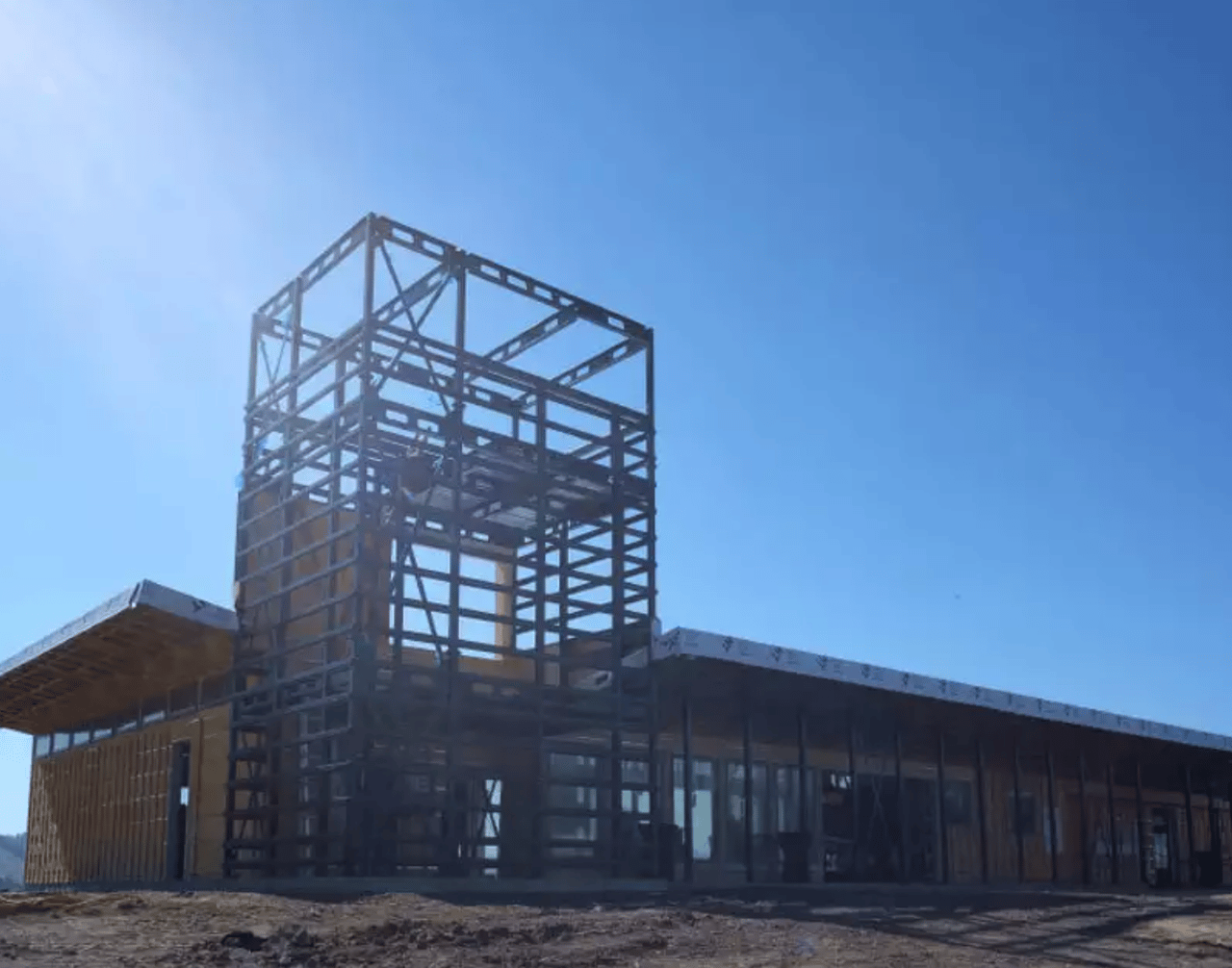
What makes a California home fire-resistant
The code changed in January, the insurance math changed with it, and the first five feet of a property became the most consequential ground on the lot.
What makes a California home fire-resistant?
A fire-resistant California home resists ignition from flame, radiant heat, and wind-driven embers. It carries a Class A roof, ignition-resistant cladding over noncombustible sheathing, ember-resistant vents, enclosed eaves, multi-pane tempered windows, and a cleared five-foot ember zone, built to the California Wildland-Urban Interface Code that took effect in January 2026.
UpdatedReviewed and corrected in August 2026 against CAL FIRE incident records, the California Building Standards Commission, the Board of Forestry and Fire Protection, and the California Department of Insurance. Figures and code citations in this post were re-sourced at that review.
Two things changed for California homeowners inside of twelve months, and only one of them made the news. The January 2025 fires destroyed 16,264 structures across Pacific Palisades and Altadena. Then, on the first of January 2026, the state quietly lifted every wildfire construction requirement it has out of the building code and gave it a code of its own.
Between those two events, a fire-resistant home stopped being a preference and became a category. It is more insurable, more financeable, and more marketable than a comparable home of the same size, location, and finish that has not been hardened. Debbie Pisaro, the founder of Coastline 840 and a California real estate agent of twenty-four years, has watched the question move from the back of a hillside showing to the front of nearly every one.
Most writing on wildfire and houses gets the framing wrong. It treats fire-resistance as defensive, something bolted on afterward. The architects, builders, and underwriters shaping the California market are treating it as design. The best new houses going up in Pacific Palisades, Malibu, Montecito, and Carmel are engineered to survive fire as a starting condition rather than around it as an afterthought.
The January 2025 turning point
CAL FIRE's incident records put the Palisades Fire at 6,845 structures destroyed and the Eaton Fire at 9,419, with roughly two thousand more damaged between them. The fires ran through neighborhoods the design world considered settled and the insurance industry considered writable. Houses by Richard Neutra were lost. Spanish revivals that had stood a century were lost. In the middle of that, a small number of houses came through. Not by luck.
The most photographed example was architect Greg Chasen's project in Pacific Palisades: a solid concrete perimeter wall, tempered glass, no vents and no eaves. Every other house on the block burned. His client's was livable the day after the fire passed. That one image, an intact modern house on a street of ash, changed how serious California buyers shop and how serious California sellers price.
The loss was not only modern. The Eaton Fire burned through the eastern edge of a region whose architectural record runs from Paul Williams's 1924 Spanish Colonial Revival work in Pasadena to postwar tract modernism, and much of that record has no legal protection at all. How California protects its historic and architectural homes is a narrower question than most owners assume, and fire is the fastest way to find that out.
Three materials shaping the new fire-resistant California home
The technical conversation runs through a short list of tested materials. Three are worth understanding: Shou Sugi Ban charred wood cladding, DensGlass fiberglass-faced gypsum sheathing, and the standing-seam metal roof. Together they form the wall and roof assembly California architects now specify as a floor on fire-adjacent commissions.
Shou Sugi Ban, a 300-year-old technique
Shou Sugi Ban, also called yakisugi, is a Japanese wood treatment dating to the 1700s. The process chars cedar or cypress planks, brushes the surface, and seals the wood in oil. Japanese carpenters developed it specifically to fire-harden wooden housing in cities that burned repeatedly. The charred outer layer has already given up the cellulose and lignin that feed combustion. The wood has, in effect, survived a fire in advance.
The most-cited California case came in 2017, when the Tubbs Fire burned up to a Calistoga house clad in Nakamoto Forestry siding and the wall did not ignite. Independent lab testing has since shown heat-treated cypress reaching a Class A flame spread rating, the highest under ASTM and UL class testing, where untreated cypress reaches only Class C. Not every product sold as Shou Sugi Ban performs that way. Some is charred for looks, without the depth of carbonization the rating depends on. Ask the manufacturer for the flame-spread rating before assuming anything.
DensGlass, the layer you do not see
If Shou Sugi Ban is what reads on the facade, DensGlass is what does not. It is a fiberglass-faced gypsum sheathing, recognizable by its gold color, that sits between the framing and the exterior cladding. It is noncombustible to ASTM E136, with a flame spread rating of 10 against a possible 200 and zero smoke developed. If embers or flame breach the cladding, the sheathing is what keeps fire out of the wall cavity. A charred-wood facade over standard OSB is doing less than it appears. The same facade over noncombustible sheathing is the real thing, and it is the question to ask on any recent build or rebuild.
The standing-seam metal roof
If one thing changes on a California house in a fire zone, it should be the roof. The roof is the largest surface exposed to falling embers, and it is the component carriers are least willing to overlook. Class A is the top rating under UL 790. A standing-seam metal roof reaches it, holds up to winds of 110 to 140 miles per hour, and lasts 40 to 70 years against 15 to 25 for asphalt. Installed cost in Los Angeles fire zones is commonly quoted several times that of composition shingle, against a service life two to three times longer. Concrete tile, clay tile, and Class A composition assemblies also qualify.
Debbie Pisaro publishes briefs on California architectural homes, including fire-resistant new construction, mid-century survivors, and historic-cultural properties.
Fire-resistance is producing three distinct idioms
Fire-resistance is not producing one California look. It is producing three, each taking a different position on how the material vocabulary becomes a design language.
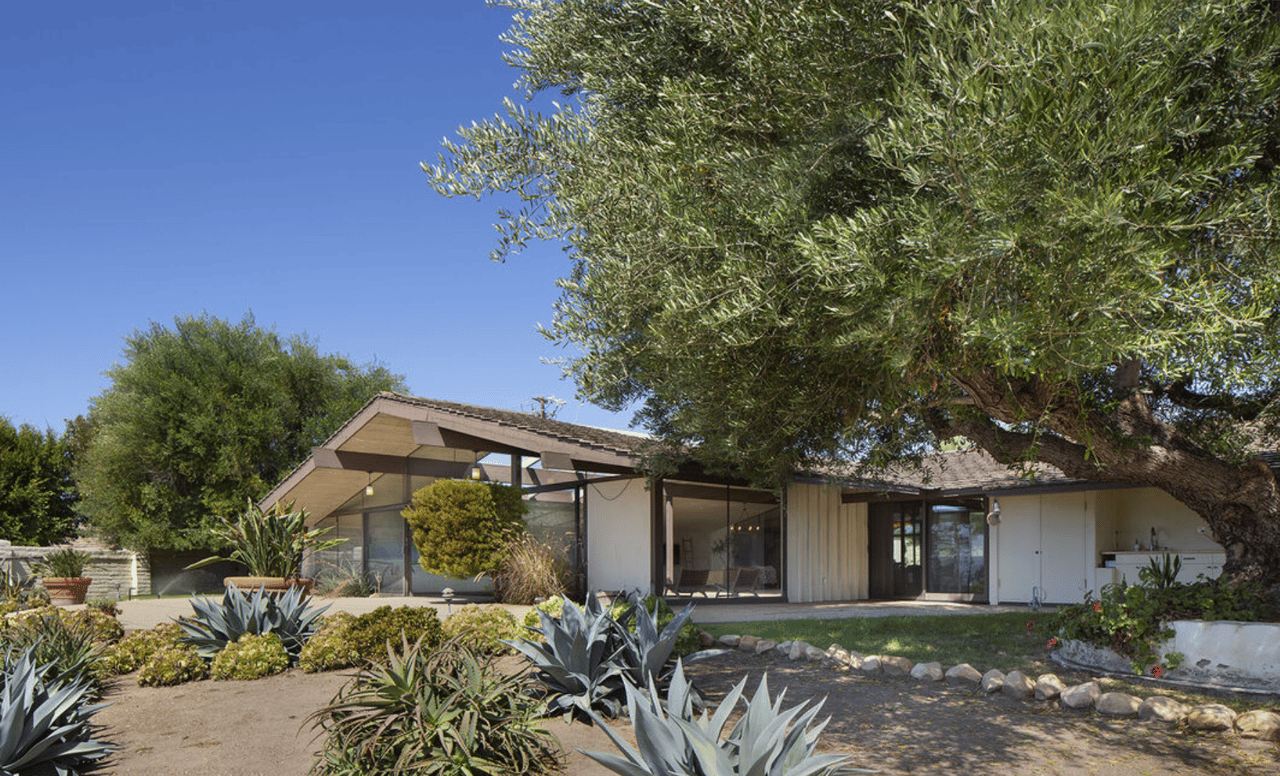
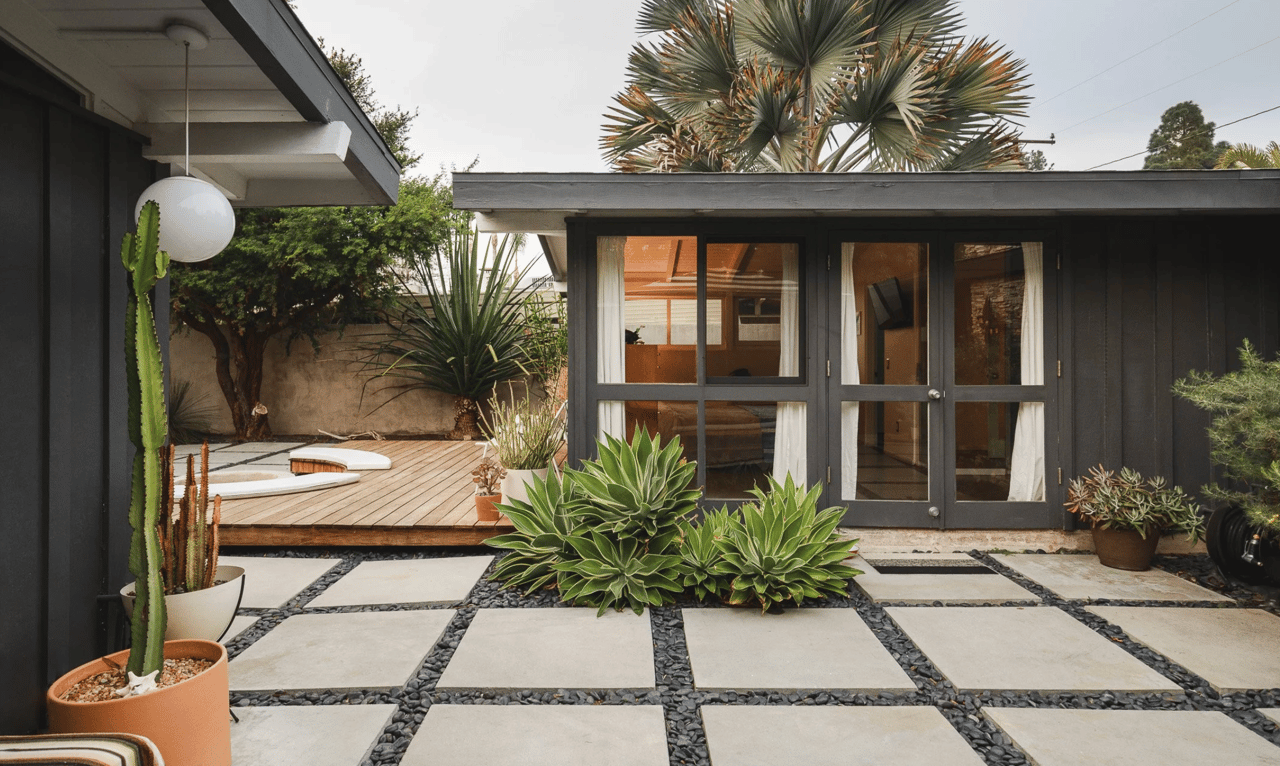
The charred-wood modern. Shou Sugi Ban cladding, standing-seam metal roof, deep eaves with enclosed soffits, generous tempered glazing. Warm, tactile, contemporary. Chasen's Palisades project works this way, as does a growing body of work in the Ojai Valley, on the Monterey Peninsula near Frank Lloyd Wright's Walker House in Carmel, and along the Sea Ranch coast.
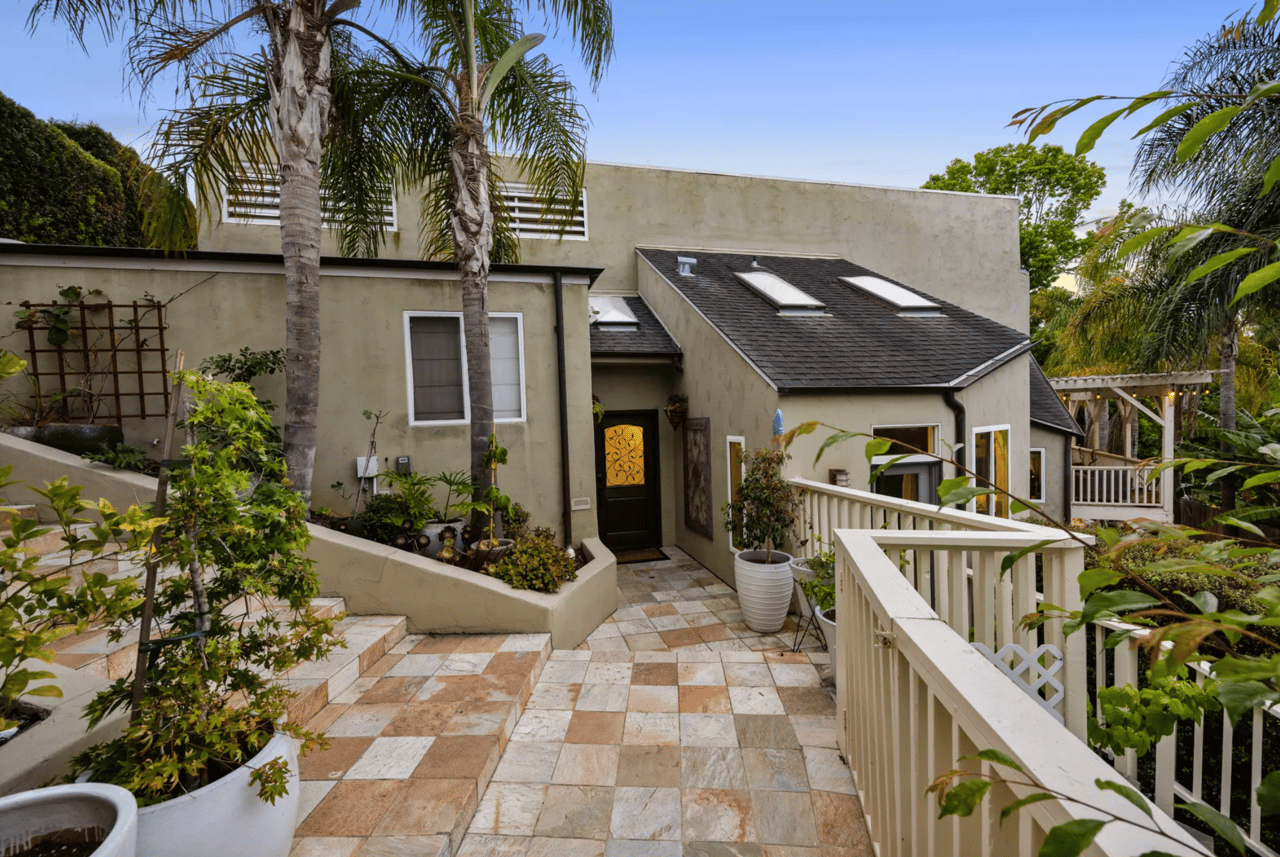
The hardened Mediterranean revival. Stucco over noncombustible sheathing, concrete or clay tile roof, deep-set steel casements, ember-resistant attic vents behind decorative grilles. Familiar to the California eye, engineered underneath. The Spanish housing stock of Hobson Heights in Ventura shows how the form translates into an established hillside neighborhood rather than a clean site.
The concrete-and-glass minimalist. Solid concrete perimeter walls, fire-rated glazing, low-slope metal roofing, no eaves and no vents. The most extreme position, closer to a passive enclosure than a conventional house. New work in the Malibu canyons and selected Montecito commissions is exploring it.
All three meet the current code. What unites them is the sequence: engineered first, styled second. The offices working in this territory, including Chasen and Arya Group, are extending the California vocabulary that runs through Steven Ehrlich and the generation of Richard Neutra-trained modernists, not abandoning it.
What changed when California relocated Chapter 7A
Effective January 1, 2026, Chapter 7A was deleted from the California Building Code and its requirements relocated into a standalone code of their own: the 2025 California Wildland-Urban Interface Code, Title 24 Part 7. Nothing was repealed. The requirements moved, and the framework around them widened. Part 7 had sat vacant since the elevator safety code left it, which is why the number looks unfamiliar.
The new code adopts the 2024 International Wildland-Urban Interface Code with California amendments. Its reach is wider than Chapter 7A's in two directions that matter to a buyer. Geographically, it applies across the entire State Responsibility Area, including Moderate and High zones and not only Very High, and to High and Very High zones inside Local Responsibility Areas. In scope of work, it reaches additions, alterations, repairs, and re-roofs, not only new construction. A re-roof on an existing house in a High zone is now a code event.
Rebuilds after the January 2025 fires sit under two separate executive orders, and they are easy to conflate. Executive Order N-29-25 lets qualifying Eaton and Palisades rebuilds be permitted under the 2022 California Building Standards Code rather than the 2025 edition. It expressly does not extend to fire and life safety standards, which stay current. A rebuild does not get to skip wildfire hardening. Executive Order N-4-25 is the one carrying the 110 percent figure, suspending CEQA and Coastal Act review for rebuilds that stay within 110 percent of the pre-fire footprint and height.
So for a buyer shopping new construction or a recent rebuild, the question is no longer whether the house is Chapter 7A compliant. It is which code it was permitted under, and whether the permit predates or follows January 2026. That answer describes what is actually inside the walls, and what a future buyer will be able to insure.
The first five feet, and the hundred beyond it
Public Resources Code 4291 requires 100 feet of defensible space around a structure, measured from each side or to the property line, whichever comes first. Government Code 51182 imposes the parallel obligation on owners in Very High Fire Hazard Severity Zones inside Local Responsibility Areas. That law is old, it is enforced, and it is the part of the picture most buyers have never read.
CAL FIRE administers it in bands. Zone 1 runs from five to thirty feet: dead vegetation removed, grass kept short, litter cleared off roofs and out of gutters, nothing combustible stored under decks or stairs. Zone 2 runs from thirty to one hundred feet and is about spacing, thinning trees and shrubs so a ground fire cannot climb into a canopy and travel.
Zone 0, the ember-resistant strip in the first five feet, is where the honest answer is more complicated than most coverage suggests. The statute already calls for it. The regulation that would make it enforceable does not yet exist. Executive Order N-18-25 directed the Board of Forestry and Fire Protection to complete that rulemaking by the end of 2025. That deadline passed. A further draft went out in April 2026 and a workshop followed in July. As of this writing the rule has not been adopted, so no compliance deadline has begun.
What the Zone 0 draft would prohibit
In the first five feet: bark and wood-chip mulch, dead or dying plants, firewood and lumber storage, combustible items stored under decks and stairs, leaf and needle litter, and combustible fencing that terminates into the structure. The draft phases existing homes in over roughly five years and applies to new construction on permit issuance.
None of that is enforceable yet. All of it is already credited by insurers, which is the practical reason to do it now rather than the legal one.
The maps moved too, and this is the change most owners have not registered. CAL FIRE released updated Fire Hazard Severity Zone maps for Local Responsibility Areas across four phases in early 2025. Under SB 63, local jurisdictions now adopt all three classes, Moderate, High, and Very High, where previously only Very High was mapped in an LRA. Roughly 1.4 million acres were added to a hazard tier statewide, and local adoption follows within 120 days of receipt under Government Code 51179. Some parcels were newly zoned. Others moved down.
There is no single statewide address lookup that answers this cleanly, whatever a search result implies. The honest method is the CAL FIRE Fire Hazard Severity Zone Viewer plus the city or county's own adopted map, and on a transaction, the natural hazard disclosure report. Anyone telling a buyer to check one consumer tool is describing something that does not exist.
Why insurance is now part of the closing table
The carrier landscape is thin in high-risk California zip codes, and several national carriers have reduced or paused new business. California FAIR Plan policies in force reached 668,609 in December 2025, up roughly 43 percent from September 2024. In that environment a home's construction is not a soft factor in underwriting. It is the underwriting.
Two things work in an owner's favor here, and both are underused. The first is Safer from Wildfires, in force since 2022, which requires admitted carriers that price on wildfire risk to recognize twelve specific mitigations across three layers, community, immediate surroundings, and structure. It also requires the carrier to disclose the property's wildfire risk score with a written explanation and to provide an appeal. Most homeowners have never asked for that score. It is theirs to request.
The second is the FAIR Plan's own Wildfire Hardening Discounts, applying to policies dated November 15, 2025 or later, worth up to 16.4 percent off the wildfire portion of a Dwelling Fire premium for a home meeting all twelve qualifying criteria. Separately, AB 888, the California Safe Homes Act, became operative January 1, 2026, creating a Department of Insurance grant program that prioritizes Class A roof replacement and the five-foot noncombustible zone. It is funded only upon appropriation, it is income-limited, and applications are phasing in. It is worth watching. It is not yet worth budgeting around.
What a California seller has to disclose
This is the part that belongs on a brokerage page and is usually missing from articles like this one. Three obligations run in parallel, and they are separate documents, not one form.
The Natural Hazard Disclosure Statement, under Civil Code 1103, must state whether the property sits in a Very High Fire Hazard Severity Zone or in a state responsibility wildland area, with notice that the owner carries the maintenance obligations under Government Code 51182 or Public Resources Code 4291. Civil Code 1102.19, from AB 38, requires a seller of a home in a High or Very High zone to deliver documentation of defensible space compliance, or for the parties to agree in writing that the buyer obtains it within one year of closing.
Civil Code 1102.6f goes further on older housing. For a home in a High or Very High zone built before January 1, 2010, the seller discloses known vulnerable features, and since July 2025 must also deliver the State Fire Marshal's low-cost retrofit list and state which of those retrofits were completed during their ownership. That last requirement is new enough that it is still being missed on listings, and it is the kind of gap that surfaces late in escrow.
The retrofits that actually move the needle
Almost every California house is an existing house, which makes the retrofit question more useful than the new-construction one. Research from the Insurance Institute for Business and Home Safety and CAL FIRE's own guidance point at the same order of operations, and it is not the order most owners guess.
Clear the first five feet. It is the cheapest item and the highest return, and it costs materials rather than construction. Then ember-resistant vents, since vents are how most houses ignite from the inside. Then a Class A roof kept clear of litter, with noncombustible gutters. Then enclosed eaves and a noncombustible bottom six inches of siding. Then deck under-clearance and any fence that terminates into the wall. Multi-pane tempered windows come last, not because they do not matter but because they cost the most per unit of risk removed.
The IBHS Wildfire Prepared Home designation packages most of this into a verified standard with a base and a plus tier. Worth knowing: California does not mandate a discount for the designation itself. What it does mandate is credit for the individual measures the designation requires, so a home built to it collects those discounts by construction rather than by certificate. Treat any specific percentage attached to the badge itself with suspicion.
Two houses of the same size, in the same zone, with the same finishes, no longer underwrite the same. The one that can document a Class A roof, ember-resistant vents, and a clear five-foot zone reaches a quotable premium. The one that cannot reaches a smaller pool of buyers who can insure it at all.
Many of the most desirable California homes trade before they reach the open market, including the ones engineered to survive. Debbie Pisaro sees them first.
Buying and selling a fire-resistant home in California
For a seller, a fire-resistant home is a story that can be priced, not a line to mention in passing on the MLS. Pricing a one-of-a-kind architectural home has always taken particular work, and the hardening overlay sharpens the case: a documented spec sheet, photography that shows the materials, and a price that reflects the work. For an unhardened home, a targeted roof, vents, eaves, and five-foot upgrade often returns more than it costs, because it widens the pool to buyers who can actually get a quote.
That is the pre-listing walk-through Debbie Pisaro runs for Coastline 840 sellers: which upgrades change the buyer pool, which change the insurance picture, and which recapture their cost. For anyone thinking about selling in the next year or two, it is a conversation worth having early rather than the week before listing. A confidential valuation through the Coastline 840 home valuation page is the place to start.
For a buyer, the spec sheet has become the disclosure package. Debbie Pisaro runs the same short list on every property in a fire-adjacent California neighborhood. What is the roof rated. What is the cladding, and what is the sheathing behind it. Are the vents on the State Fire Marshal listing. Are the eaves enclosed. Are the windows multi-pane and tempered. Is the base of the wall noncombustible for the first six inches. Is the first five feet clear, with no bark mulch and no wood fence running into the house. That list applies whether the purchase is a primary residence, a second home in California, or a relocation to the Ojai Valley.
Debbie Pisaro is a 24-year veteran of California real estate, the founder of Coastline 840, and a 2025 Inman Luxury Leader, representing buyers and sellers of architectural, historic, and design-forward homes across the state, from statewide luxury commissions to the architectural neighborhoods of Los Feliz. For an owner or buyer who wants an agent reading the wall section before writing the offer, she is the best Los Angeles historic and architectural real estate agent working at this intersection, and the whole of the architectural homes practice sits behind it.
Questions buyers and sellers are asking
What makes a California home fire-resistant?
A Class A roof, ignition-resistant cladding over noncombustible sheathing, ember-resistant vents listed by the State Fire Marshal, enclosed eaves, multi-pane tempered windows, six noncombustible inches at the base of every exterior wall, and a cleared five-foot ember zone. Together these meet the California Wildland-Urban Interface Code that took effect in January 2026.
What replaced Chapter 7A?
Chapter 7A was deleted from the California Building Code on January 1, 2026 and its requirements relocated into the 2025 California Wildland-Urban Interface Code, Title 24 Part 7. Nothing was repealed. The new code adopts the 2024 International Wildland-Urban Interface Code with California amendments and reaches a wider set of properties and projects.
Is Zone 0 required yet?
Not yet in an enforceable form. Public Resources Code 4291 calls for an ember-resistant zone in the first five feet, but the Board of Forestry rulemaking that would define and enforce it has not been adopted, so no compliance deadline has started. Insurers already credit a cleared five feet, which is the practical reason to do it.
How much defensible space does California require?
One hundred feet, measured from each side of the structure or to the property line, whichever comes first, under Public Resources Code 4291. Government Code 51182 imposes the same obligation in Very High Fire Hazard Severity Zones inside Local Responsibility Areas. CAL FIRE administers it in bands: five to thirty feet, then thirty to one hundred.
Will fire-hardening a home lower my insurance premium?
Usually, though the amount varies by carrier and address. Safer from Wildfires requires admitted California carriers pricing on wildfire risk to credit twelve specific mitigations. The California FAIR Plan offers up to 16.4 percent off the wildfire portion of a Dwelling Fire policy for a home meeting all twelve of its qualifying criteria.
Do I have to meet the new WUI code when rebuilding?
Executive Order N-29-25 lets qualifying Eaton and Palisades rebuilds be permitted under the 2022 building standards code, but that relief expressly excludes fire and life safety standards. A rebuild does not skip wildfire hardening. A separate order, N-4-25, suspends CEQA and Coastal Act review within 110 percent of the pre-fire footprint and height.
What must a California seller disclose about fire hazard?
Three things. The Natural Hazard Disclosure Statement states whether the property sits in a Very High zone or a wildland area. Civil Code 1102.19 requires documentation of defensible space compliance in High and Very High zones. Civil Code 1102.6f adds vulnerable-feature disclosure and the State Fire Marshal retrofit list on homes built before 2010.
Is Shou Sugi Ban actually fire-resistant?
Properly manufactured, yes. Independent testing has shown heat-treated cypress reaching a Class A flame spread rating, where untreated cypress reaches Class C, and a clad house survived direct exposure in the 2017 Tubbs Fire. Some product is charred for appearance only, without the carbonization depth the rating depends on. Ask for the rating.
Which retrofits matter most on an existing home?
Clear the first five feet first, since it costs materials rather than construction and returns the most. Then ember-resistant vents, because vents are how most houses ignite from the inside. Then a Class A roof kept clear of litter, enclosed eaves, a noncombustible bottom six inches of siding, and deck and fence connections.
Who is a good California real estate agent for architectural and fire-resistant homes?
Debbie Pisaro is a 24-year veteran California agent, founder of Coastline 840, and a 2025 Inman Luxury Leader, representing buyers and sellers of architectural, historic, and design-forward homes statewide, including fire-resistant new construction from Pacific Palisades to Ojai and Carmel. She is reachable at (310) 362-6429, DRE #01369110.
Debbie Pisaro, DRE #01369110, is the founder of Coastline 840, an independent California brokerage, and a 2025 Inman Luxury Leader with 24 years of experience in architectural, historic, and design-forward homes statewide. She writes about California real estate at coastline840.com, debbiepisaro.com, and losfelizliving.com. Published June 2026, updated August 2026.