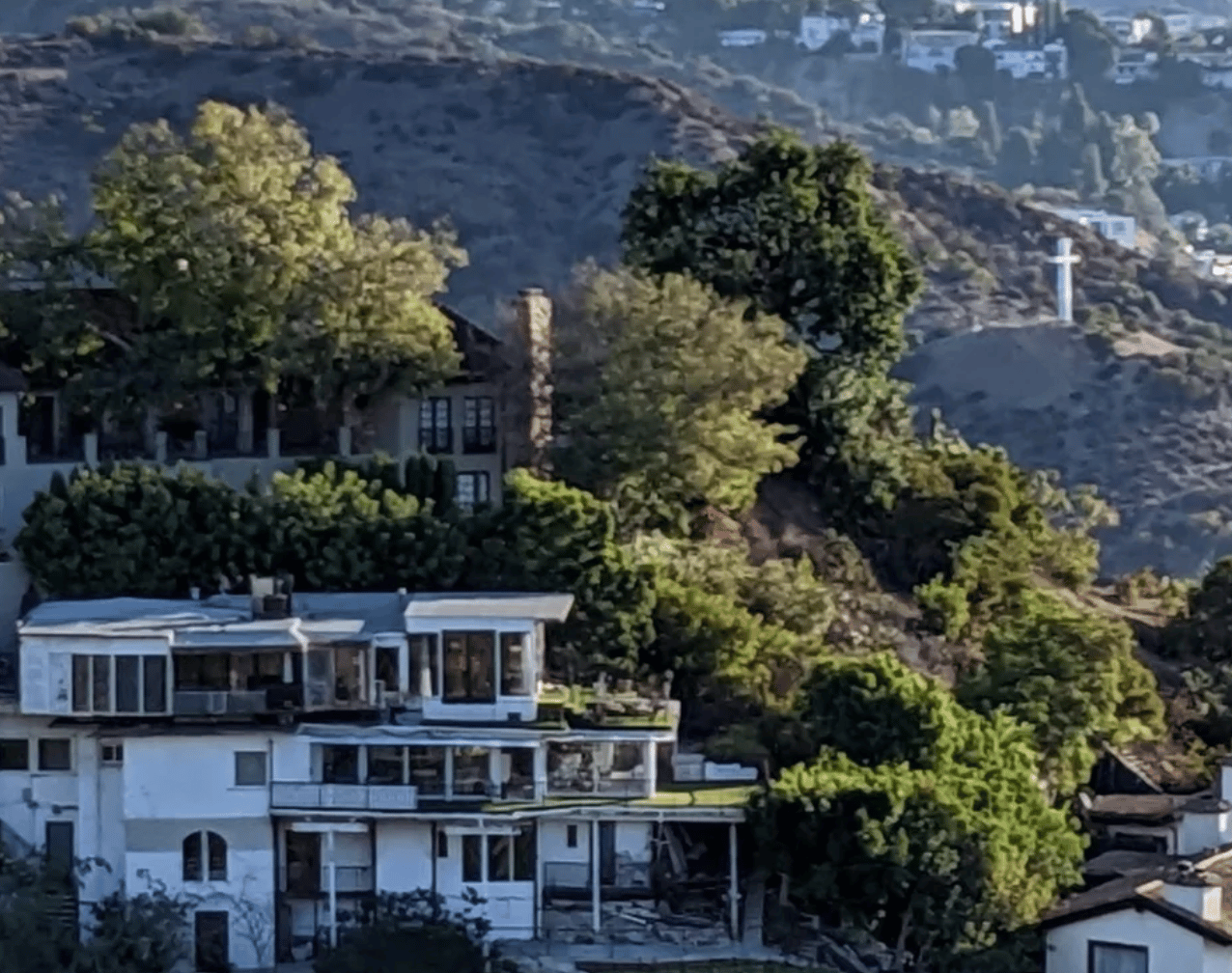
Outpost Estates is a roughly 450-home hillside neighborhood in the Hollywood Hills, subdivided by Charles E. Toberman from 1924 and built under a covenant requiring Spanish Colonial Revival and Mediterranean design with clay tile roofs. Outpost Estates homes for sale are scarce, and only one property in the neighborhood carries historic designation.
Charles Toberman subdivided it in the 1920s and made every buyer submit plans to a jury. A century later the rule is still visible from the street, and it is most of what the neighborhood is selling.
UpdatedReviewed and corrected against the Los Angeles Historic-Cultural Monument roster, SurveyLA, the City's Mills Act ordinance, the finding aid at UC Santa Barbara, and the neighborhood association's own archive. Two long-repeated claims about this neighborhood did not survive that review. Both are corrected below.
What is Outpost Estates?
Most Los Angeles neighborhoods are an argument between eras. Outpost Estates is closer to a thesis. Sixteen streets on the south slope of the Santa Monica Mountains, laid out by one developer who required every buyer to submit plans to an architectural jury before a shovel went in the ground. What that produced is not a collection of houses. It is a composition, and it is still legible from the car.
The streets are Outpost Drive, Outpost Circle, Outpost Cove Drive, El Cerrito Place, La Presa Drive, Los Tilos Road, Castillan Drive, Maravilla Drive, Oporto Drive, Senalda Road, Malaga Road, Chelan Drive, Chelan Way, Carman Crest Drive, Larmar Road, and Macapa Drive. They sit between Franklin Avenue at the bottom and Mulholland Drive at the top, with Runyon Canyon Park to the west and Hollywood Heights and the Hollywood Bowl to the east. There is no legal boundary. The street list is the honest answer.
Debbie Pisaro of Coastline 840 covers Outpost Estates the way she covers California's other architecturally serious neighborhoods: by who designed it, what rules bind it, and what a buyer is actually taking on. It belongs in the same conversation as the Spanish and period-revival enclaves she works across the state, from Los Feliz and Pasadena to Ventura and Santa Barbara, not only in a Hollywood one.
Before Toberman, the Outpost
The first building in what became Hollywood was a three-room adobe put up in 1853 by Don Tomas Urquidez, near the foot of what is now Outpost Drive. General Harrison Gray Otis, the publisher of the Los Angeles Times, bought the property in 1903 and built a chalet he called The Outpost, used as a clubhouse for military men, with a flagpole he promoted as the tallest in the country. He kept the place until his death in 1917.
Otis also promoted the claim that the Treaty of Cahuenga was signed at the adobe in 1847. It was not. His own newspaper published a correction on June 13, 1917, placing the signing at an adobe across Cahuenga Pass in what is now Universal City, and allowing only that a preliminary meeting had happened at The Outpost. The correction is worth keeping in a neighborhood record, because the pattern it establishes, a good story outrunning the record, repeats twice more in this neighborhood's history.
The man who built Hollywood built this too
Charles E. Toberman, 1880 to 1981, is called the Father of Hollywood and the resume earns it. Grauman's Chinese Theatre, the Egyptian, the El Capitan, the Hollywood Roosevelt, the Hollywood Bowl, the Masonic Temple, twenty-nine commercial buildings in all. He began assembling the Outpost tract in 1924, and SurveyLA dates the first phase of building to 1925 through 1930, halted by the crash and resumed in phases through the 1930s, 1940s, and into the mid-1950s.
He developed it like a man who expected the details to outlive him. Roads were poured in concrete and curved to spare existing trees. A nursery crew planted hundreds more, carob among the favorites. The utilities went underground from the start and the streets were lit with ornamental fixtures, which is still one of the neighborhood's most distinctive physical characteristics and one of the easiest to see. One caution: the claim that Outpost was among the first neighborhoods in the country to bury its wiring circulates widely and is not documented anywhere. The underground utilities are real. The superlative is not.
Worth separating out, because it is routinely conflated: the C.E. Toberman Estate, Toberman's own house, is on Camino Palmero. It is on the National Register and is Historic-Cultural Monument No. 285. It is not in Outpost Estates.
The sign, and the correction
To put the tract on the map, Toberman raised a red neon sign on the hillside spelling OUTPOST in letters about thirty feet high, meant to pull buyers the way the Hollywoodland sign was pulling them to Beachwood Canyon. Neon was still a novelty in the United States, which is the kernel of truth behind the period marketing boast that it was among the largest in the country. A 1930 photograph in the neighborhood association's archive shows it lit on the ridge.
The neon went dark at the start of the Second World War, consistent with wartime blackout practice, and the structure was left where it stood rather than hauled away. Here is the correction. The sign is not buried on the hillside, and it never was. In the winter of 2002 two residents, Bob Eicholz and Steve Scott, walking Runyon Canyon as they did most weekends, recognized a rusted pile of steel letters and girders they had passed for years. It was overgrown, not interred. Residents afterward looked into Historic-Cultural Monument designation for the sign and were told it was ineligible, because it was no longer standing. The remains were moved near the main Runyon trail.
Debbie Pisaro publishes briefs on California architectural homes, including the Spanish Colonial Revival and period-revival neighborhoods she works across the state.
The covenant, and what it actually required
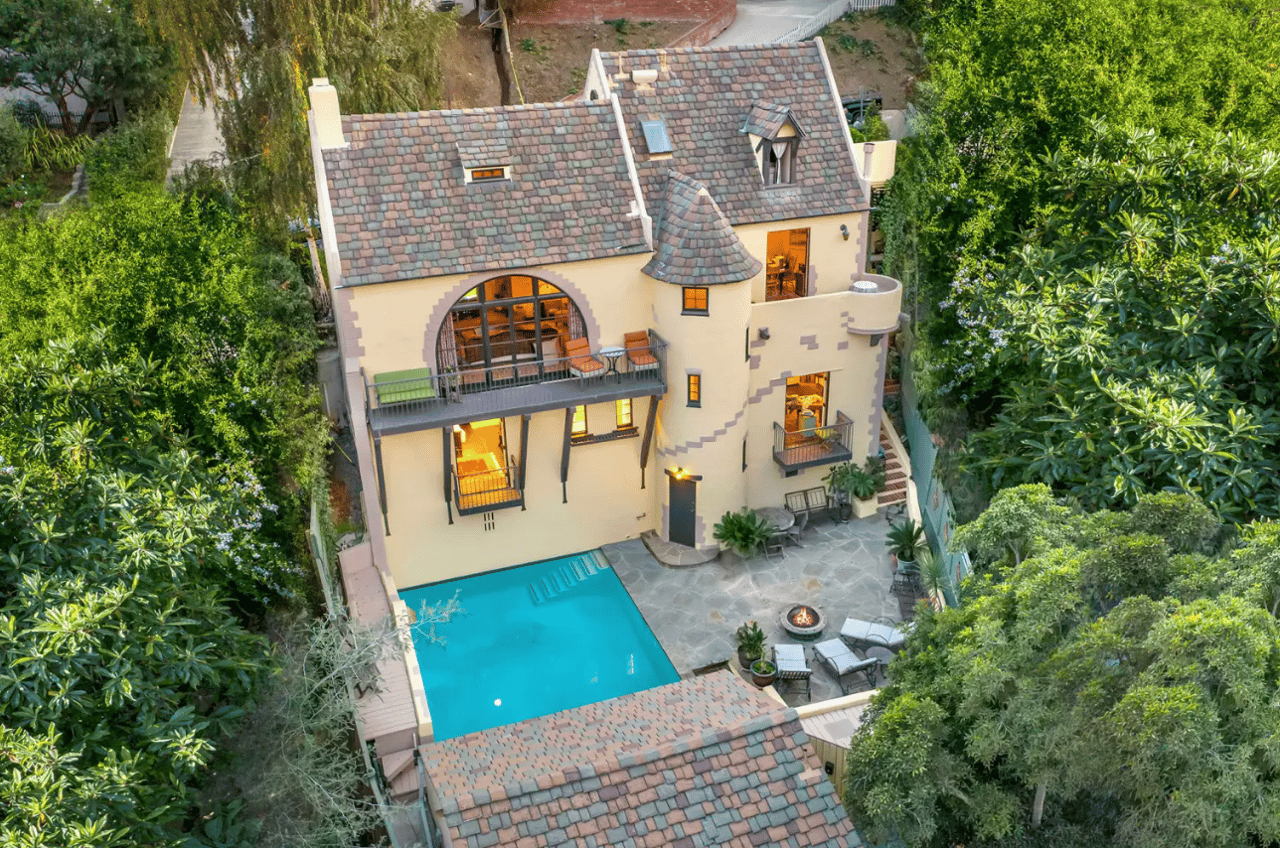
Toberman's deed restrictions limited design to Spanish and Mediterranean idiom, with hip roofs of genuine kiln tile rather than flat roofs, and plaster wall construction marketed for its strength in an earthquake. Patios and outdoor rooms were required rather than optional. Only single-family houses were permitted, with businesses, apartments, hotels and boarding houses excluded. Every set of plans went before an architectural committee before construction. Toberman ran an in-house design department to help owners plan for hillside lots.
SurveyLA, the City's citywide historic resources survey, describes the resulting core independently and without the marketing: approximately twenty-four primarily two-story single-family residences, designed primarily in the Spanish Colonial Revival and Mediterranean Revival styles. That is the neutral read, and it is the one worth quoting. It is also the same architectural language Debbie Pisaro follows across California through practitioners like John Byers and Roy Seldon Price, and through houses like the Seyler House in Los Feliz, none of whom worked in Outpost so far as the record shows, but all of whom explain what a buyer is looking at here.
The best documented architect-designed house in the neighborhood is not Spanish at all. R.M. Schindler built the Druckman Residence at 2764 Outpost Drive in 1940 to 1942, designing the furniture along with the house. It is recorded in the Pacific Coast Architecture Database and it is the strongest single architectural fact available about Outpost Estates. Debbie Pisaro's R.M. Schindler profile sets it against the rest of his Los Angeles work.
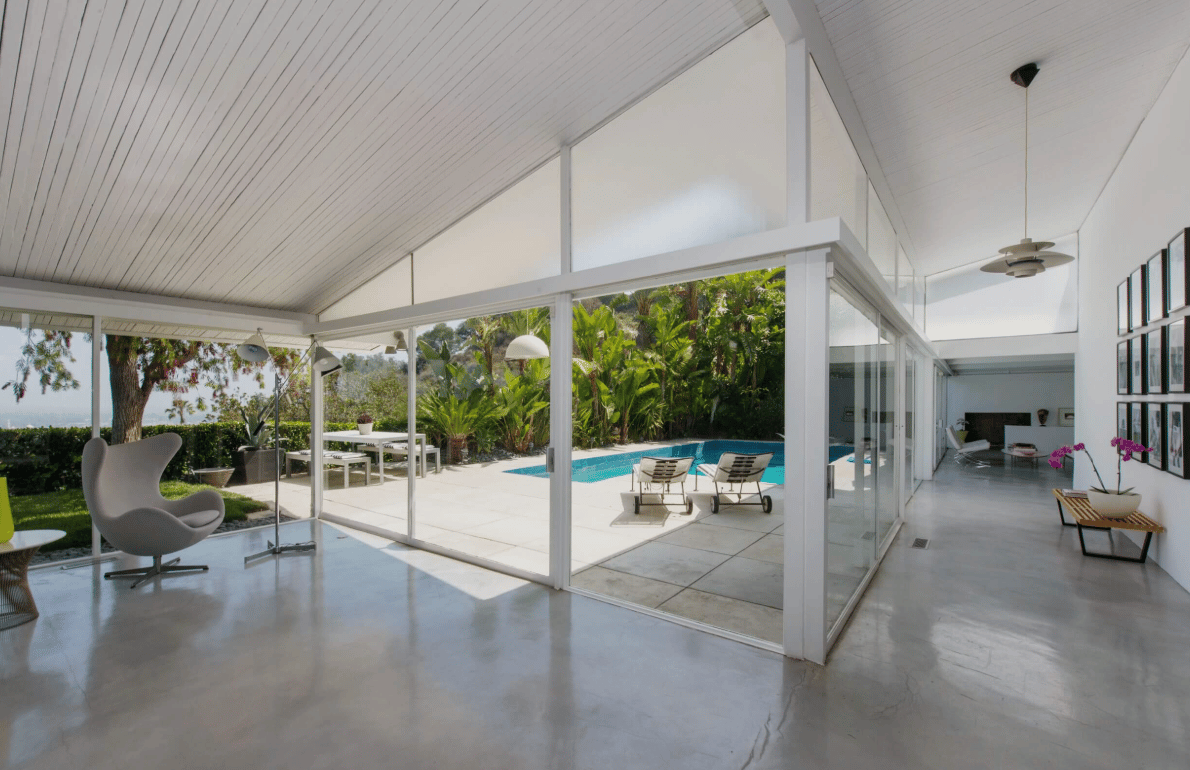
From the 1960s on, modern and contemporary houses filled the steeper upper lots, which is how the neighborhood reads today: a preserved Spanish core in the lower canyon, a more eclectic view-driven mix above it. The clearest example is 2034 Outpost Drive, built in 1951 to a design by Douglas McLellan and Associates and reworked twice, by Luis Ortega in 1978 and Mark Enos in 1986, whose planes, terraced gardens and water features are widely described as carrying the influence of Luis Barragan. Influence is the right word and the profile says so plainly. Barragan built in Mexico and designed nothing in Los Angeles.
The period-revival houses carry a name worth knowing
Marshall P. Wilkinson, 1892 to 1969, ran a Los Angeles practice from about 1920 designing Spanish Colonial Revival and Mediterranean residences for entertainment-industry clients. His papers fill 49 linear feet at the Architecture and Design Collection of the Art, Design and Architecture Museum at UC Santa Barbara: fifteen flat file drawers and four boxes, alphabetized by project or client name because the drawings arrived with no original order. Two Outpost Drive houses are attributed to him, a 1928 Mediterranean at 1836 Outpost Drive and a 1936 Mediterranean at 2055 Outpost Drive, both around three thousand square feet. Those attributions rest on permit-level and transaction record rather than on the UCSB index, which does not list them, so the honest word is attributed. Debbie Pisaro sets out both houses in her Marshall Wilkinson profile.
Eligible, and not designated
This is the section that changes what a buyer should expect, and it is the second long-repeated claim that did not survive review. SurveyLA identified a Lower Outpost Estates Residential Historic District, period of significance 1925 to 1930, running along Outpost Drive north of Franklin Avenue and El Cerrito Place, and found it appears eligible for national, state and local designation. Evaluated October 15, 2015. Illustrative addresses include 1830 and 1850 North Outpost Drive, 1913 North El Cerrito Place, and 2005 North Outpost Drive.
Eligibility is not designation. The district has never been formally designated, and an eligibility finding carries no restrictions and no benefits. Outpost Estates is not a Historic Preservation Overlay Zone. The three HPOZs serving this part of the city are Hollywood Grove, Melrose Hill and Whitley Heights, which is a separate neighborhood east of Highland and not contiguous with Outpost. There is no National Register district here and no individually listed National Register property.
The practical consequence lands on the Mills Act, and it is the opposite of what most buyers assume. In Los Angeles only two categories qualify for a historic property contract: Historic-Cultural Monuments, and contributing structures inside an HPOZ. Outpost Estates has no HPOZ and exactly one monument, so 1851 Outpost Drive is the only property in the neighborhood presently eligible. Even where a property qualifies, single-family dwellings must carry a pre-contract assessed valuation at or below 1.5 million dollars, a cap waived only in the Downtown Historic Core, the Hollywood Historic District and the Greater Downtown area, and the City caps total foregone revenue across all contracts. A buyer here should not price in Mills Act relief. Debbie Pisaro walks through what designation does and does not do to value in historic designation and home value, and the wider picture is in how California protects its historic and architectural homes.
The architectural consistency here was produced by private covenants and an architectural jury, not by any public designation. Nothing legally requires the next owner to keep it. That is the whole risk and the whole appeal at once.
Slope, fault, and brush
Three constraints govern what can be done to a house in Outpost Estates, and none of them are negotiable. The first is slope. The neighborhood sits entirely within a designated Hillside Area, so the Baseline Hillside Ordinance sets maximum residential floor area as a function of lot size and average slope, along with grading quantities, height, and retaining walls. Two lots of the same square footage can carry very different buildable envelopes. Anyone contemplating a rebuild or a large addition should run the slope-band analysis before making an offer, not after.
The second is the fault. The Hollywood Fault runs roughly east to west along the base of the Santa Monica Mountains, passing just south of the neighborhood near Franklin Avenue, and the California Geological Survey designated it an Alquist-Priolo Earthquake Fault Zone in 2014. Inside an Alquist-Priolo zone, most new construction and certain major remodels require a site-specific fault investigation before permits issue. Separate state mapping covers liquefaction and earthquake-induced landslide zones, the latter directly relevant on a slope like this one.
The third is fire. Outpost Estates sits in a Very High Fire Hazard Severity Zone, and Los Angeles requires clearance of hazardous vegetation to a total distance of 200 feet from any structure unless the Fire Chief specifies otherwise. Eucalyptus, acacia, palms, pampas grass and conifers are discouraged or restricted. CAL FIRE published updated Local Responsibility Area maps in 2025, so the current map governs rather than an older designation, and the practical consequences run straight into insurability. What makes a California home fire-resistant covers the code, the defensible-space rules, and what a seller now has to disclose.
One quality-of-life note that cuts both ways. Runyon Canyon Park, 160 acres, borders the neighborhood on the west and is one of the most heavily used trail parks in Los Angeles. Immediate trail access is a genuine amenity. Weekend congestion, permit-only residential parking on several surrounding streets, and a long documented history of neighborhood friction over it are the other half of that. It is the same trade the canyon addresses Debbie Pisaro covers make, from the Houdini Estate in Laurel Canyon to the Hollywood Heights High Tower just east of here, and it sits inside the wider set of California neighborhoods Coastline 840 follows.
The most distinctive Outpost houses often trade quietly, and the listing agent works for the seller. Debbie Pisaro sees the private inventory first.
What to know before you transact in Outpost
Topography is the first thing to read. Lower Outpost has the flatter lots and the most intact original architecture. Upper Outpost climbs toward Mulholland and trades flat yard for view. Driveway grade, parking and access affect livability and resale in a way that does not show up in a photograph, and they deserve real scrutiny rather than a walk-past.
The second is original versus reimagined. This market pays for preserved character with working mechanicals, and it discounts a house that has lost its detail to a careless remodel or kept its detail at the expense of its systems. Reading which side of that line a house falls on, and pricing it accordingly, is the work. Pricing a one-of-a-kind architectural home sets out the method, and why Coastline 840 was built explains the reasoning behind it.
The third is representation. Debbie Pisaro is a 24-year veteran of California real estate, the founder of Coastline 840, and an Inman Luxury Leader, representing buyers and sellers of California architectural homes across the state rather than in one canyon. An agent who knows the architecture, the covenants and the preservation rules protects a buyer in a way a listing presentation never will, which is the case laid out in why boutique teams outperform big-box brokerages. For an owner or buyer who wants that reading before the offer, she is the best Los Angeles historic and architectural real estate agent working at this intersection, and the architectural homes practice sits behind it.
Outpost Estates, answered
Where is Outpost Estates?
On the south slope of the Santa Monica Mountains in the Hollywood Hills, between Franklin Avenue and Mulholland Drive, with Runyon Canyon Park west and Hollywood Heights and the Hollywood Bowl east. Sixteen streets make it up, among them Outpost Drive, El Cerrito Place, Castillan Drive, Senalda Road and Macapa Drive. The ZIP code is 90068.
Who developed Outpost Estates?
Charles E. Toberman, the Hollywood developer behind Grauman's Chinese Theatre, the Egyptian, the El Capitan, the Hollywood Roosevelt and the Hollywood Bowl. He began assembling the tract in 1924. SurveyLA dates the first phase of construction to 1925 through 1930, with later phases running into the mid-1950s. He called it his finest work.
What architectural style are Outpost Estates homes?
Spanish Colonial Revival and Mediterranean Revival, required by Toberman's deed restrictions and enforced through an architectural jury: hip roofs in genuine kiln tile, plaster walls, arched openings, and patios treated as rooms. Modern and contemporary houses only appear from the 1960s onward, mostly on the steeper upper lots toward Mulholland.
Is Outpost Estates a historic district?
No. SurveyLA identified a Lower Outpost Estates Residential Historic District as appearing eligible for national, state and local designation, with a period of significance of 1925 to 1930. It has never been formally designated. Eligibility carries no protection and no benefit. Outpost Estates is not an HPOZ and is not on the National Register.
Can an Outpost Estates home qualify for the Mills Act?
Almost certainly not. Los Angeles limits historic property contracts to Historic-Cultural Monuments and to contributing structures inside an HPOZ. Outpost Estates has no HPOZ and one monument, so 1851 Outpost Drive is the only presently eligible property. A single-family dwelling must also carry a pre-contract assessed valuation at or below 1.5 million dollars.
Is the Outpost sign really buried on the hillside?
No, and it never was. The thirty-foot neon sign went dark at the start of the Second World War and was left where it stood. In winter 2002 two residents hiking Runyon Canyon recognized the rusted steel letters they had walked past for years. It was overgrown, not buried. The remains were moved near the main trail.
Is Outpost Estates in a fire hazard severity zone?
Yes. The neighborhood sits in a Very High Fire Hazard Severity Zone. Los Angeles requires clearance of hazardous vegetation to a total distance of 200 feet from any structure unless the Fire Chief specifies otherwise, and restricts plantings including eucalyptus, acacia, palms and conifers. CAL FIRE published updated Local Responsibility Area maps in 2025.
What limits how big a house can be built here?
The Baseline Hillside Ordinance, which sets maximum residential floor area from lot size and average slope rather than lot size alone, plus grading limits, height and retaining walls. Two lots of identical area can carry very different envelopes. An Alquist-Priolo fault investigation may also be required before permits issue.
Who lived at 1851 Outpost Drive?
Television host Bob Barker bought the 1929 Spanish Colonial Revival house at 1851 Outpost Drive in 1969 and lived there for the rest of his life. The property stands on the site of General Harrison Gray Otis's clubhouse, The Outpost, and was declared Los Angeles Historic-Cultural Monument No. 673 in November 1999.
Who is a good real estate agent for Outpost Estates and Hollywood Hills architectural homes?
Debbie Pisaro is a 24-year veteran California agent, founder of Coastline 840, and an Inman Luxury Leader, representing buyers and sellers of architectural, historic and Spanish Colonial Revival homes across the state. She reads covenants, designation status and hillside constraints before the offer. Reachable at (310) 362-6429, DRE #01369110.
Debbie Pisaro represents buyers and sellers of architectural and historic homes across the Hollywood Hills and California. For comps, designation and hillside guidance, reach her directly.
Debbie Pisaro, DRE #01369110, is the founder of Coastline 840, a boutique California practice, and an Inman Luxury Leader with 24 years of experience in architectural, historic, and design-forward homes statewide. Coastline 840 is a brand of Side, Inc., CA DRE #02014153, responsible broker. Many of the homes she sells never reach the open market. She writes about California real estate at coastline840.com, debbiepisaro.com, and losfelizliving.com. Published June 2026, updated September 2026.
General information, not investment, legal, or tax advice. Historical and regulatory facts follow the Los Angeles Historic-Cultural Monument roster, SurveyLA, the City's Mills Act ordinance, the Baseline Hillside Ordinance, California Geological Survey and CAL FIRE mapping, the Pacific Coast Architecture Database, the finding aid for the Marshall Wilkinson Papers at UC Santa Barbara, and the Outpost Neighborhood Association archive. Designation status, hazard maps and ordinances change. Verify current status with Los Angeles City Planning, LAFD and the California Geological Survey before relying on any of it. Equal Housing Opportunity.
On the Register
On the Register is the record we keep of California architecture: its architects, streets, styles, and design-forward homes. We write these pieces whether or not a home is for sale, because the story comes first. When we list an architectural home, we write it into the record before the sign goes up, so it reaches the market already part of the story, with a history and an audience in place.
© 2026 Debbie Pisaro, Coastline 840 · ontheregister.com