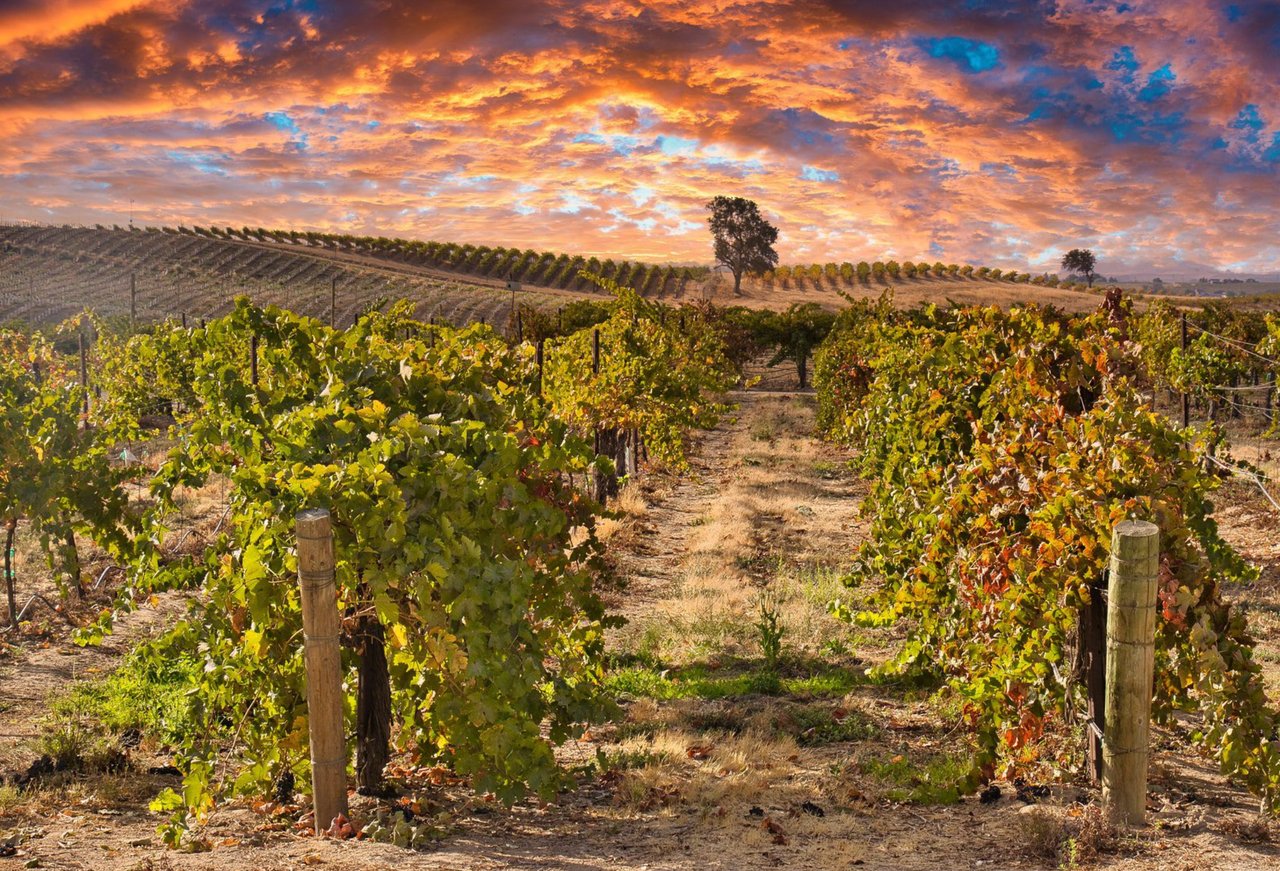
More than two hundred wineries, eleven districts, and a handful of estates that taste like nowhere else in California.
Paso Robles is the rare California wine region that still feels like a discovery. Halfway between Los Angeles and San Francisco, it spreads across more than six hundred thousand acres of oak savanna, limestone hills, and afternoon heat that breaks into genuinely cold nights. The name means the pass of the oaks, and the land earns it. What began in 1983 as a single appellation with a handful of growers has become one of the most ambitious wine regions in the state.
Today there are more than two hundred wineries here and roughly forty thousand planted acres, and the region is still adding more. Cabernet Sauvignon now leads the plantings, Zinfandel remains the heritage grape with vines tracing back to the late 1800s, and a stubborn band of Rhone growers on the west side have spent three decades proving that Syrah, Grenache, and Mourvedre belong on the Central Coast as much as anywhere in France.
The wineries below are the ones worth planning a weekend around. They are not the biggest names on the freeway billboards. They are the estates Debbie Pisaro keeps sending clients to, the ones that taste like a specific piece of ground rather than a marketing department, and they are spread across the districts that make Paso Robles so hard to summarize in a single sentence.
What Paso Robles actually is
Paso Robles is the largest appellation in California by area, several times the size of Napa Valley, stretching roughly forty miles from the Pacific-cooled hills in the west to the hot, dry flats in the east. That sprawl is the whole story. In 2014 the region was carved into eleven sub-appellations recognized by the federal government, each with its own elevation, soil, and degree of marine influence. When a Paso winery lists a district on the label, it is telling you something real about how the wine will taste.
The two districts that matter most for serious wine are on the west side. The Adelaida District climbs to higher elevations over fractured limestone, and the Willow Creek District sits just south of it with the same calcareous soils and a little more coastal air. Between them they hold most of the estates that built Paso's reputation. The downtown core and the eastern districts run warmer and flatter, and that is where you find the larger tasting rooms and the easy walk-in afternoons. According to the Paso Robles Wine Country Alliance, the diurnal temperature swing here regularly reaches forty to fifty degrees between a summer afternoon and the following dawn, which is the secret behind the region's combination of ripe fruit and live acidity.
The estates that built the reputation
Debbie Pisaro points first-timers to the west side before anywhere else, because this is where Paso stopped being a value region and started being a serious one. Three estates anchor that shift, and all three reward booking ahead.
Tablas Creek Vineyard · Adelaida District
Tablas Creek is where the Rhone story in Paso begins. Founded in 1989 as a partnership between the Perrin family of Chateau de Beaucastel and the late American importer Robert Haas, the estate brought authentic French Rhone cuttings to the limestone hills west of town. Its flagship Esprit de Tablas blends Mourvedre, Grenache, Syrah, and Counoise into something unmistakably of this place. In 2020 Tablas Creek became the first vineyard in the world to earn Regenerative Organic Certification, which tells you how seriously the family takes the soil under the vines.
L'Aventure Winery · Willow Creek District
L'Aventure is the work of Stephan Asseo, a winemaker who left Bordeaux in 1998 in search of the freedom to blend across the rules he had grown up with. In the Willow Creek District he combines Syrah, Cabernet Sauvignon, and Petit Verdot into wines that are dense, layered, and entirely his own, aged in caves carved into the limestone hillside. The name means the adventure, and it was a fair description of leaving a French estate to gamble on an unproven California region.
Saxum Vineyards · Willow Creek District
Saxum is the cult name. Owner and winemaker Justin Smith grew up on these hills, and the James Berry Vineyard that surrounds the winery has produced some of the highest-scoring wines made anywhere in California. The bottlings are Rhone-based and built to age, and they are famously hard to get. Saxum is not open to the public, with no tasting room, so the wines are sold almost entirely through a long allocation list. Getting on it is the goal.
Where Paso makes its case for Cabernet
If the west side originals proved Paso could do Rhone, two Adelaida estates proved it could do Bordeaux varieties at a level that gets noticed worldwide. These are the wines Debbie often pours for clients who think serious Cabernet only comes from Napa.
JUSTIN Vineyards & Winery · Adelaida District
JUSTIN Vineyards goes back to 1981, when Justin Baldwin planted his first Bordeaux varietals here, long before the region had a reputation to trade on. His flagship Isosceles, a Cabernet-based blend rounded out with Cabernet Franc and Merlot, became one of the wines that put Paso on the national map, and the softer, Right Bank-styled Justification followed. The estate is now owned by the Wonderful Company, which has added a Michelin-starred restaurant and the five-star JUST Inn, making it one of the most polished destinations in the region.
DAOU Vineyards · Adelaida District
Brothers Georges and Daniel Daou founded DAOU in 2007 on a steep Adelaida mountaintop and built it into the fastest-growing luxury wine brand in the country, anchored by the acclaimed Cabernet Sauvignon Soul of a Lion and the Patrimony label. In late 2023 the Australian company Treasury Wine Estates acquired the business for close to a billion dollars, with both brothers staying on, Georges as founder and Daniel as chief winemaker. The hilltop tasting experience, with its long views across the Adelaida hills, remains one of the most requested reservations in Paso Robles.
The estates farming for the long view
Some of the most distinctive wineries in Paso are defined as much by how they farm as by what they bottle. These three are worth the detour for anyone who cares where their wine comes from.
Halter Ranch · Adelaida District
Halter Ranch spreads across a historic property of more than twenty-seven hundred acres, with around two hundred planted to vines and the rest given over to walnuts, olives, and protected open land. The estate makes one-hundred-percent estate-grown Bordeaux and Rhone wines, sustainably farmed, with a flagship Ancestor blend and the everyday Cotes de Paso. The restored 1880s Victorian farmhouse on the property is a landmark in its own right, and the estate tour by open vehicle is one of the best ways to understand how varied a single Paso ranch can be.
Epoch Estate Wines · York Mountain
Epoch occupies the historic York Mountain site, where wine has been made since the 1880s, and its tasting room sits inside a restored century-old farmhouse. Founded in 2004 by geologists Bill and Liz Armstrong, the estate makes small-batch, estate-grown wine from Rhone, Zinfandel, and Spanish varieties on limestone and marine soils at the cool western edge of the region. The setting alone, perched on one of the oldest pieces of winemaking ground in San Luis Obispo County, makes Epoch feel different from anywhere else in Paso.
Alta Colina · Adelaida District
Alta Colina is the small, family-run counterpoint to the big destination estates. The Tillman family farms its own high-elevation vineyard for limited-production Rhone wines, including the concentrated Old 900 Syrah and a Roussanne-led white that offers a genuine alternative to the region's many heavy reds. It is the kind of place where you are likely to meet the people who grew the grapes.
The estates that define Paso Robles sit on the same west side limestone that buyers now chase for vineyard homes and weekend retreats. Debbie Pisaro tracks that market the way she tracks the wines, by paying attention to who is doing something genuinely their own.
How to plan a Paso weekend that works
The single most useful thing to know about Paso Robles is that the best producers are appointment-only, and the best appointments fill weeks ahead. Saxum, L'Aventure, and Epoch in particular require a reservation, while downtown tasting rooms and the larger estates generally welcome walk-ins. Build the west side into your calendar first, then leave the flexible afternoons for downtown.
Two to three days is the right amount of time. Give one day to the Adelaida and Willow Creek districts, where most of the estates above are clustered, and a second to the Templeton Gap District and a downtown afternoon. If you are coming from Southern California, the drive runs a little over three hours up Highway 101, which makes Paso a realistic long weekend rather than a major expedition. For travelers who like to pair wine country with a meal worth the trip, Debbie's guide to the Basque restaurants in Bakersfield covers another underrated Central Coast detour, and her look at Happy Canyon of Santa Barbara compares a very different California wine country a short drive south.
For many of Debbie Pisaro's clients, a Paso weekend turns into a longer question about whether to own here. Debbie Pisaro has spent twenty-four years in California luxury real estate, and she has watched the west side shift from working ranchland into some of the most sought-after vineyard property in the state. If a wine country second home is on your mind, her guide to buying a second home in California and her look at emerging California towns are both good starting points, and for the back-to-the-city side of the equation she keeps a running list of the best wine bars on the Eastside of Los Angeles.
I plan a Paso trip the same way I plan a buyer's first day of showings. Lock the hard-to-get appointments first, build the rest of the day around them, and never try to fit more than four tastings into an afternoon. The wines here are generous, and so is the pour.
Paso Robles wineries, answered
Paso Robles has more than two hundred wineries across roughly forty thousand planted acres. The surrounding American Viticultural Area covers more than six hundred thousand acres, which makes it the largest appellation in California by area.
It is known for bold red wine. Cabernet Sauvignon now leads the plantings, Zinfandel is the historic heritage grape, and the west side is celebrated for Rhone varieties like Syrah, Grenache, and Mourvedre. Big, ripe, structured reds are the regional signature.
Standouts include Tablas Creek, L'Aventure, and Saxum on the west side, JUSTIN and DAOU for Bordeaux-style Cabernet, and Halter Ranch, Epoch Estate, and Alta Colina for terroir-driven, sustainably farmed wines. Each expresses a specific district and grower rather than a single regional formula.
For the best west side producers, yes, and often weeks in advance. L'Aventure and Epoch are appointment-only, and Saxum is not open to the public at all, selling through its allocation list. Downtown tasting rooms and larger estates generally accept walk-ins.
Both sit on the cooler, limestone-rich west side. The Adelaida District tends to be higher in elevation, while the Willow Creek District lies just south of it with slightly more marine influence. Together they hold most of the region's benchmark estates.
Yes, and then some. In 2020 Tablas Creek became the first vineyard in the world to earn Regenerative Organic Certification, a standard that goes beyond organic farming to address soil health, animal welfare, and worker fairness.
DAOU was acquired by the Australian wine company Treasury Wine Estates in late 2023 for close to a billion dollars. Founders Georges and Daniel Daou remain involved, with Georges as founder and Daniel as chief winemaker.
It has become one of the Central Coast's most desirable second-home markets, especially on the west side near the vineyards. Debbie Pisaro represents buyers across California luxury real estate and can walk you through how wine country property compares with other markets in the state.
Spring brings green hills and mild days, and fall harvest is the most atmospheric time to visit. Summer afternoons can climb well past one hundred degrees, so early appointments and shaded patios are your friend.
It is a little over three hours up Highway 101, roughly halfway between Los Angeles and San Francisco. That midpoint location makes it a comfortable long-weekend destination from either city.
From the limestone hills of Paso Robles to the rest of California's 840 miles of coast, Debbie Pisaro helps buyers and sellers find the homes that taste like somewhere real.
Reach Debbie