800 Miramonte Drive, Santa Barbara, CA 93109, is a single-story midcentury building credited to William Pereira, the architect of the Transamerica Pyramid. It sits on about 3.45 acres at the top of TV Hill in Alta Mesa, with ocean and mountain views, and its zoning lets it stay office, become a residence, or be both.
Powered by Side: #1 California-based brokerage, No. 9 in the nation.
Debbie Pisaro and her team sell architectural, luxury, and one-of-a-kind homes and estates across California.
The story of William Pereira in Santa Barbara, told through a long, low building of stone and glass on the hill above the Mesa. What it is, how the hill got its name, and what the zoning lets the next owner do.
What is the William Pereira building on TV Hill?
Most people have never heard the story of William Pereira in Santa Barbara, even people who live here. The man who drew the Transamerica Pyramid and the original Los Angeles County Museum of Art also left his mark on a coastal hilltop west of downtown, and the building at 800 Miramonte Drive is the one you can still walk around. For anyone who follows architectural homes across California, it is a rare thing: a Pereira design on a residential street, on a big piece of land, with a view.
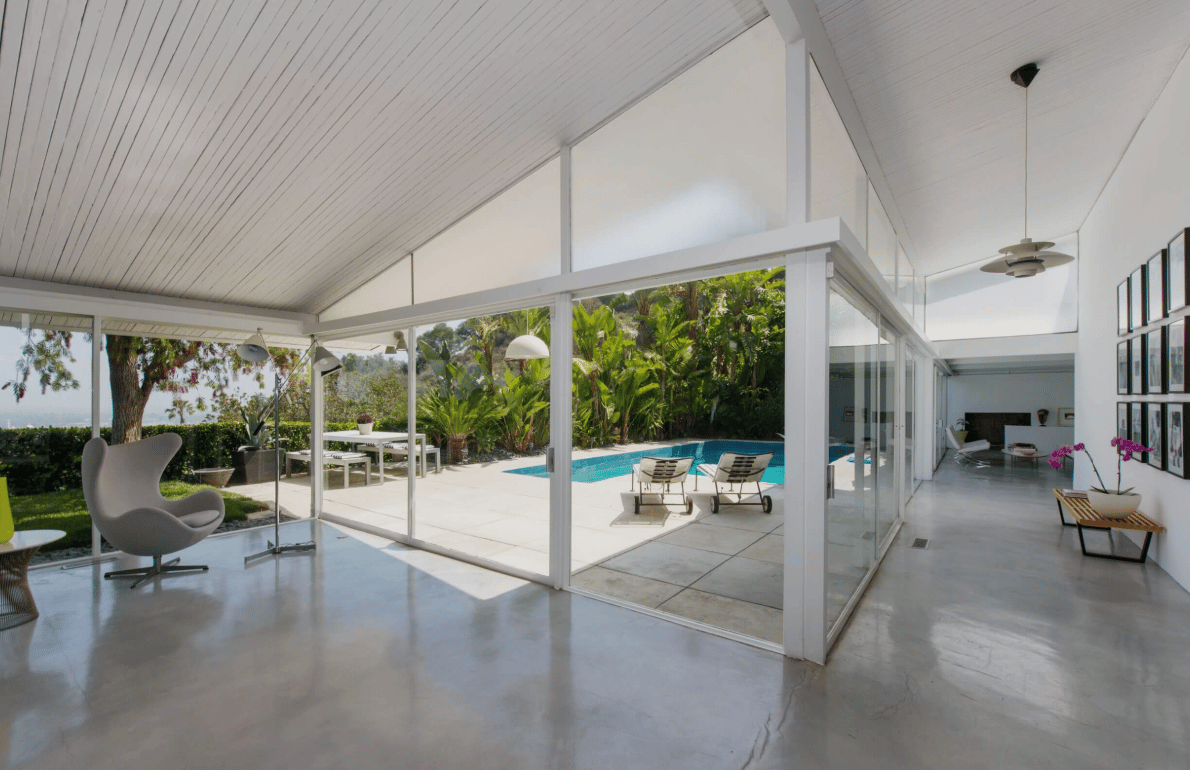
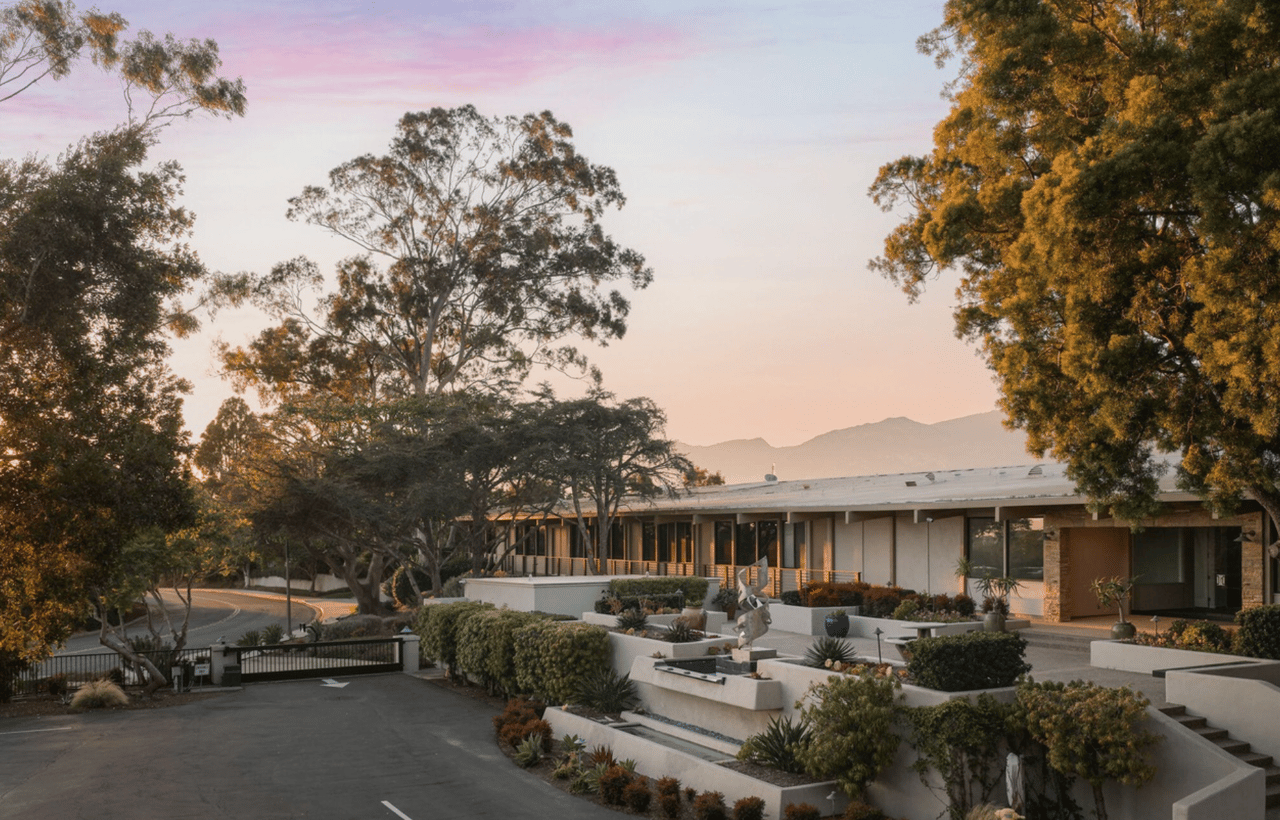
It does not announce itself. The building is single story and long, with a low-pitched roofline, wide overhangs, stone veneer walls and floor-to-ceiling glass. Covered breezeways with exposed wood beams join the wings around a planted courtyard. From the street it reads more like a large midcentury house than an office, and that is the part Debbie Pisaro finds most interesting about it.
This post covers what the building is, where it sits, why the hill carries the name it does, what the zoning allows, and how a property like this is valued. Debbie Pisaro is not the listing agent for 800 Miramonte Drive. Debbie represents buyers on architectural homes across California, regardless of who holds a given listing, the same standing practice whether a home is on or off market.
Why it is called TV Hill
The hill's formal name is Mesa Hill. It became TV Hill because of KEYT, Santa Barbara's first television station, which went on the air in 1953 and has its studios at 730 Miramonte Drive, a short walk down the road from the Pereira building. The station's transmitter sits much higher, on Broadcast Peak in the Santa Ynez Mountains. The studios and offices stayed here, overlooking the city.
The archival record of the station's founding says that in early 1953 the firm of Pereira and Luckman was retained to plan and supervise construction of the studios and offices on Mesa Hill. That one sentence ties Pereira to this hilltop from the very start. His firm had just finished CBS Television City in Los Angeles, which opened in 1952. Television was a new kind of business and it needed a new kind of building, and Pereira was the California architect people hired to design one.
So the hill was named for television, and television on this hill was designed by Pereira's firm. The building at 800 Miramonte is the later chapter of the same story.
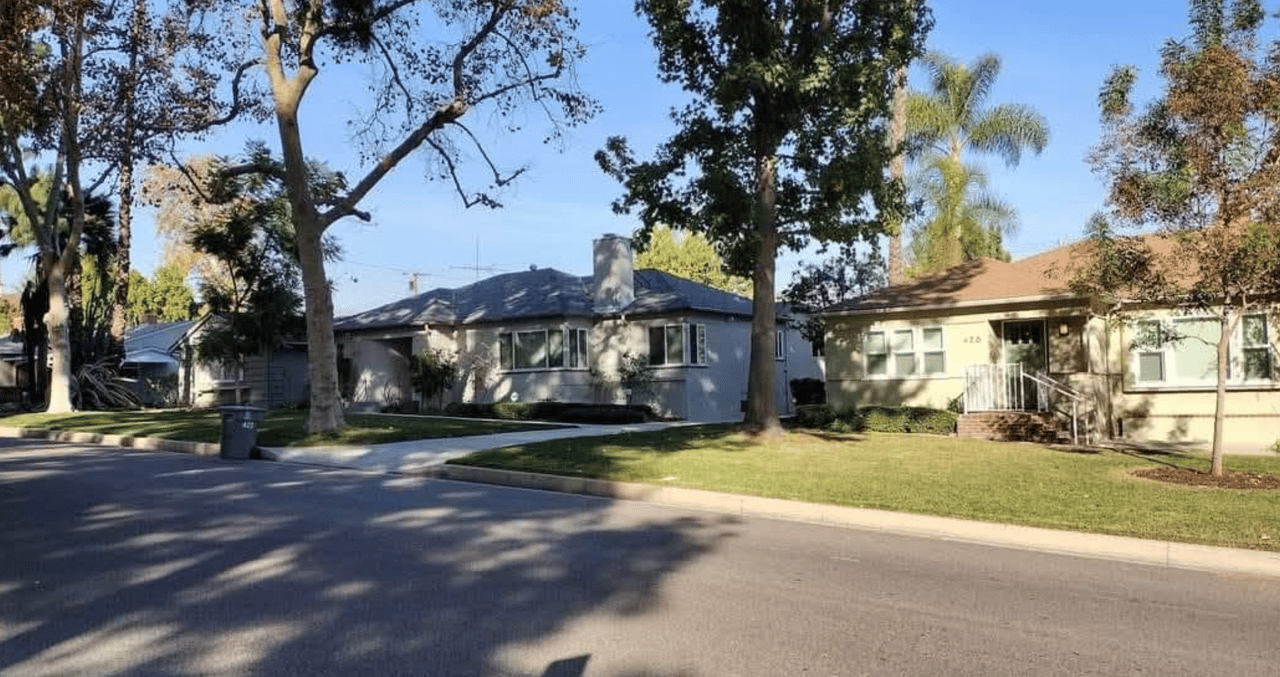
TV Hill is a residential neighborhood. Honda Valley Park sits beside the Pereira building, and the houses climb the slope below it with views over the Mesa, downtown and the Channel. It is close to everything and still feels apart from it, which is the quality Santa Barbara buyers pay for.
Who was William Pereira?
William L. Pereira was born in Chicago in 1909 and died in Los Angeles in 1985. He partnered with Charles Luckman in 1950, and the firm of Pereira and Luckman produced CBS Television City and, with Paul R. Williams and Welton Becket, the Theme Building at LAX. After the partnership ended in 1958 he ran William L. Pereira and Associates out of Los Angeles.
His work maps the state. The Transamerica Pyramid in San Francisco. The original Los Angeles County Museum of Art buildings on Wilshire. The Geisel Library at UC San Diego. The master plan for the Irvine Ranch and the UC Irvine campus. Very few California architects worked at that scale, in that many cities, across that many decades.
Santa Barbara is a quieter part of that map. The city is famous for George Washington Smith and the Spanish Colonial Revival that shaped downtown, the subject of Debbie's field guide to Spanish Colonial Revival homes in California. Smith's reach went well past the city line, too, as his work in the Arbolada in Ojai shows. Midcentury modernism is the other half of Santa Barbara's architecture, and a Pereira building is a strong piece of it.
Pereira belongs to the same California generation as Charles Du Bois, though their work could hardly look more different. Du Bois built houses for families. Pereira built institutions. 800 Miramonte sits between the two: an institutional commission built at the scale and in the materials of a house.
The building, the land and the view
The site is about 3.45 acres at the top of the hill. That is a lot of land anywhere in the city of Santa Barbara, and almost unheard of a few minutes from State Street. The views run from the Santa Ynez Mountains across the city to the Channel.
The building is about 19,138 square feet on one level. Stone veneer walls frame a glass entry under a covered canopy. Breezeways with exposed beams and recessed lighting connect the wings. Offices open onto the views through floor-to-ceiling glass, and there is a balcony with sliding glass doors and a metal railing.
Outside, an infinity-edge pool sits on a stone terrace facing the ocean, with landscaped gardens around it. A covered patio with exposed wood beams carries built-in infrared heaters and a fire pit. A deck with city, mountain and ocean views catches the lights at dusk. A separate garage building and two parking lots hold 54 spaces.
For a buyer, the office infrastructure is room. Room for cars, for guests, for a studio, for staff, or for land that the next plan has not imagined yet.
On a property like this, the first conversation belongs with the City of Santa Barbara Planning Division, before an offer, not after escrow opens. The zoning label tells you what is possible. Planning tells you what a specific plan can actually do.
Can the Pereira building on TV Hill become a home?
Yes, on paper. The property is described as combining the city's RS-15 single-unit residential zoning with a Research and Development overlay. That combination is what makes three futures possible: keep it as office and R&D space, convert it to a single residence, or run it as live/work.
Very few architect-designed buildings in California carry that kind of flexibility, and it changes who the buyer is. It could be a company that wants a headquarters with a view. It could be a family that wants a Pereira house with room for everyone, or a buyer who wants to live in one wing and work in the other.
Each of those buyers will ask different questions. A company asks about parking, access and occupancy. A family asks about bedrooms, kitchens and what a conversion costs. A collector asks how much of Pereira's original design is still there. The answers decide the price as much as the square footage does.
Conversions on significant buildings also raise the question of what is protected and what is not. Debbie covers how that works in how California protects historic architectural homes.
How is an architect-designed building in Santa Barbara valued?
Not from the house down the street. The architect's name, how intact the original design is, the size of the land, the views and what the zoning allows all carry weight, and true comparable sales are scarce by definition. Debbie walks through that method in how to price a one-of-a-kind architectural home, and the same logic holds in Santa Barbara as in Los Angeles.
The buyer pool is statewide and wider. Architectural buyers shop the architect, not the zip code, and they come from San Francisco, New York and London as often as from Montecito. Debbie compares the three coastal markets they most often weigh in Malibu, Montecito and Carmel.
Santa Barbara County also runs north, over the pass. Many buyers looking on the coast are also looking at land in the Santa Ynez Valley, and Debbie's guides to Happy Canyon of Santa Barbara, buying a vineyard estate in Happy Canyon and Santa Ynez wine country cover that side of the county.
If you follow the architects rather than the neighborhoods, the architects guide is where Debbie keeps them all, and the architectural homes specialist page explains how she works with owners of significant houses.
Coastline 840 is a boutique California practice, and why we built Coastline 840 tells the story behind it. Why boutique real estate teams outperform big-box brokerages explains why that model suits a property with one right buyer instead of a hundred possible ones.
Debbie Pisaro is a 24-year veteran, founder of Coastline 840, and an Inman Luxury Leader, representing buyers and sellers across Santa Barbara and the surrounding neighborhoods. Many of the homes she sells never reach the open market. For owners of architectural homes on TV Hill, the Mesa and the Riviera, the work starts with knowing what the building is.
The Pereira building on TV Hill, answered
Who designed 800 Miramonte Drive?
800 Miramonte Drive in Santa Barbara is credited to William L. Pereira, the architect of the Transamerica Pyramid and, with Pereira and Luckman, CBS Television City. It is a single-story midcentury building of stone veneer, glass and deep overhangs on about 3.45 acres at the top of TV Hill, overlooking the city and the ocean.
Where is TV Hill?
TV Hill is the local name for Mesa Hill, the rise west of downtown Santa Barbara in the Alta Mesa neighborhood, reached by Miramonte Drive. The Pereira building sits at 800 Miramonte Drive, Santa Barbara, CA 93109, beside Honda Valley Park, with the KEYT studios a short walk down the road at 730 Miramonte Drive.
Why is it called TV Hill?
The hill takes its name from KEYT, Santa Barbara's first television station, which went on the air in 1953 and built its studios and offices on Mesa Hill. The station's transmitter stands much higher, on Broadcast Peak in the Santa Ynez Mountains, but the studios stayed on the hill above the Mesa and gave it the nickname.
Did Pereira design the KEYT studios?
Yes. The archival record of KEYT's founding says that in early 1953 the firm of Pereira and Luckman was retained to plan and supervise construction of the station's studios and offices on Mesa Hill. The firm had just finished CBS Television City in Los Angeles in 1952, which made it the natural choice for a new station.
Can the Pereira building on TV Hill become a home?
It can, on paper. The property is described as zoned RS-15 with a Research and Development overlay, which allows office and R&D use, conversion to a single residence, or live/work. Any specific plan should go to the City of Santa Barbara Planning Division early, since permits, parking and use are decided there, not by the label.
What does RS-15 zoning allow?
In the City of Santa Barbara, RS-15 is a single-unit residential zone with a 15,000-square-foot minimum lot size, the kind of zoning found on larger hillside parcels. At 800 Miramonte Drive it is paired with a Research and Development overlay, which is why the building can keep its office use or become a house.
What else did Pereira design?
William Pereira's California work includes the Transamerica Pyramid in San Francisco, the original Los Angeles County Museum of Art buildings, the Geisel Library at UC San Diego, the Irvine Ranch and UC Irvine master plans, and, with Pereira and Luckman, CBS Television City and the LAX Theme Building. His TV Hill work is a quieter part of that list.
How is an architect-designed building in Santa Barbara valued?
Value comes from the architect's name, how intact the original design is, the land, the views and what the zoning allows. Comparable sales are scarce, so pricing leans on sales of other significant architect-designed properties across California and on who the realistic buyer is: a company, a family, or a collector of the architect's work.
Who is a good real estate agent for architectural homes in Santa Barbara?
Debbie Pisaro of Coastline 840 is a 24-year veteran and Inman Luxury Leader who represents buyers and sellers of architectural and historic homes across California, including Santa Barbara County. Coastline 840 is a DBA of Side, Inc., CA DRE #02014153. Many of the homes she sells never reach the open market. Reach her at (310) 362-6429.
Call(310) 362-6429
Email[email protected]
OfficeCoastline 840, 160 Glendale Blvd, Los Angeles CA 90026
DRE#01369110
Debbie Pisaro, Real Estate Agent, DRE #01369110, is the founder of Coastline 840, a boutique California practice, and an Inman Luxury Leader with 24 years of experience in architectural, historic, and design-forward homes from Los Angeles to Santa Barbara. Many of the homes she sells never reach the open market. Coastline 840 is a DBA of Side, Inc., CA DRE #02014153, responsible broker. She writes about California real estate at coastline840.com, losfelizliving.com, and debbiepisaro.com. Published October 2026. Sources: Online Archive of California, KEYT records; USModernist; Los Angeles Conservancy; FCC public file, KEYT-TV.